
A major housing association has been downgraded by the Regulator of Social Housing following an inspection that uncovered weaknesses in repairs, damp and mould management and the information provided to its board. Housing Ombudsman decisions reveal the consequences of serious failures experienced by individual residents.
Home Group, one of England's largest housing associations, has lost its top governance rating after the Regulator of Social Housing identified shortcomings in the oversight of repairs, property conditions, building safety and tenant accountability.
In a regulatory judgement published on 28 October 2026, the regulator downgraded Home Group's governance rating from G1 to G2 and awarded the organisation its first consumer rating of C2. Its financial viability assessment remained unchanged at V2.
Although all three grades indicate that Home Group continues to meet the regulator's fundamental requirements, the findings raise important questions about how effectively the organisation has monitored problems affecting residents and whether its leadership has received sufficient information to scrutinise service performance.
The regulator acknowledged improvements already made by Home Group, particularly in repairs, but warned that further progress was required and that the organisation must demonstrate those improvements can be sustained.
Concerns over what the board was being told
Among the most significant findings were weaknesses in the information presented to Home Group's board.
The regulator identified shortcomings in reporting concerning property conditions, building safety, health and safety, repairs, damp and mould and tenant accountability.
Crucially, reports did not always provide sufficient clarity about the scale, age and risks associated with outstanding problems. This limited the board's ability to scrutinise performance effectively and ensure that necessary improvements were being delivered.
Home Group's governance arrangements were considered appropriate for an organisation of its size, and the regulator recognised evidence of effective challenge when directors received clear and robust information.
If those responsible for governing a housing association are not consistently receiving a clear picture of outstanding repairs and risks, how can they be confident that the organisation is responding effectively to problems affecting people's homes?
However, the inspection found that oversight was not consistently effective across important areas of consumer services and regulatory compliance.
The regulator also identified a need for stronger board oversight of assurance reviews and their recommendations, helping the organisation recognise recurring problems and address their underlying causes.
For residents, these findings raise a fundamental question. If those responsible for governing a housing association are not consistently receiving a clear picture of outstanding repairs and risks, how can they be confident that the organisation is responding effectively to problems affecting people's homes?
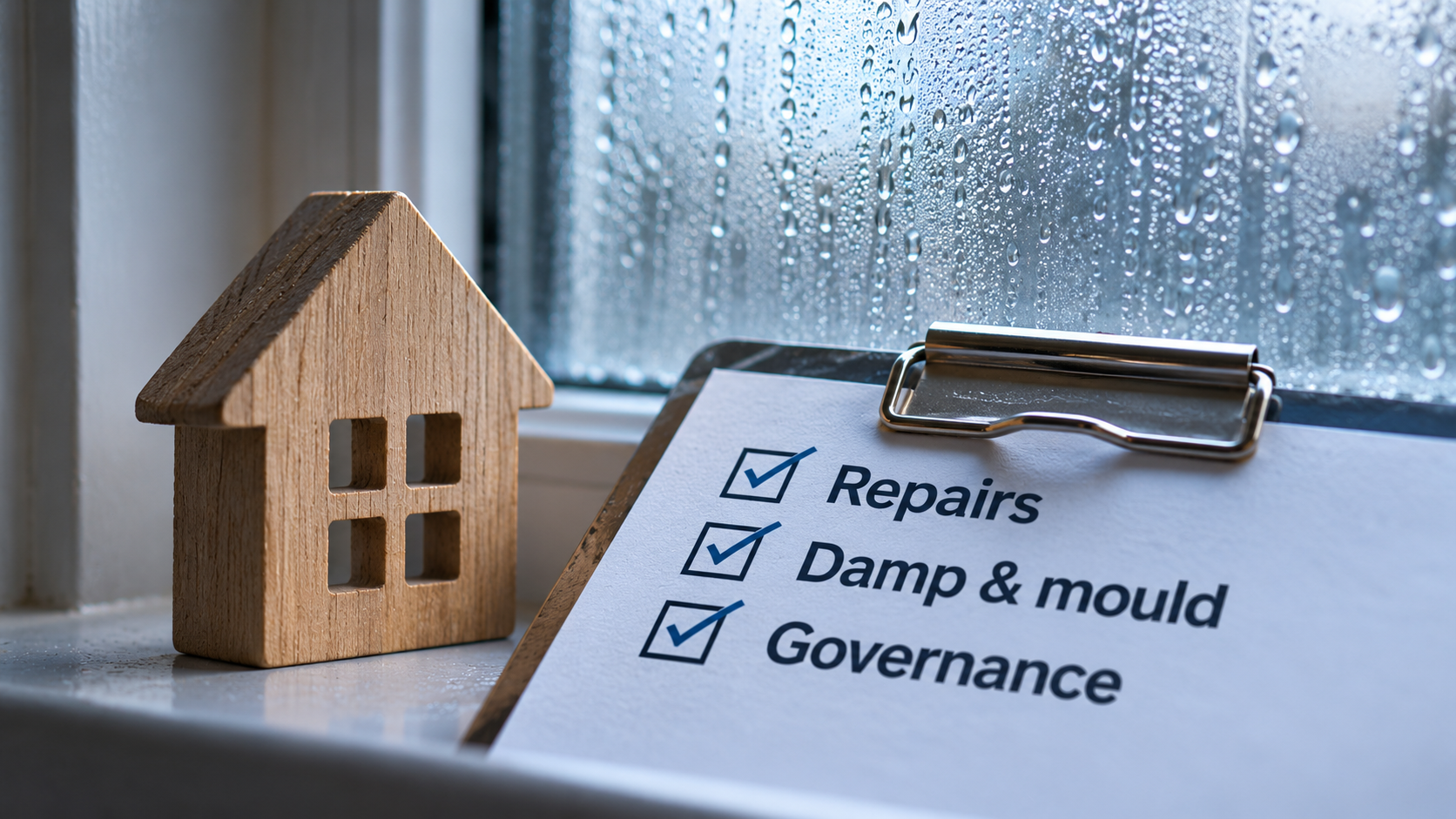
Repairs, damp and mould remain a concern
The inspection also uncovered weaknesses in Home Group's handling of repairs and damp and mould.
Although the regulator recognised improvements in the timeliness and effectiveness of repair services, the level of overdue repairs remained too high.
Home Group had taken steps to reduce its backlog, but the regulator wanted evidence that those improvements would continue.
Its management of damp, mould and condensation presented further concerns, with high numbers of cases and evidence that reports were not always being addressed within appropriate timescales.
The regulator also found that some properties lacked sufficient stock-condition information, while others relied on surveys conducted more than ten years earlier.
For residents living with persistent leaks, damp or outstanding repairs, delays and inadequate communication can have a substantial impact on daily life.
Although most homes had received recent surveys, gaps in the information available to Home Group could affect its understanding of property conditions and the planning of future improvements.
The inspection highlighted the importance of tailoring repairs services to residents' needs and vulnerabilities, as well as keeping tenants properly informed about work being undertaken.
These are not simply administrative matters. For residents living with persistent leaks, damp or outstanding repairs, delays and inadequate communication can have a substantial impact on daily life.
Ombudsman decisions reveal the human consequences
The regulatory judgement comes against a background of serious findings against Home Group by the Housing Ombudsman.
Individual Ombudsman decisions cannot establish the overall standard of service across every Home Group property. However, several recent decisions document failures involving the same issues highlighted by the regulator.
In one particularly serious case, published on 19 December 2025, the Ombudsman made two findings of severe maladministration and four additional findings of maladministration.
The resident had reported numerous problems shortly after moving into her home in 2021, including cracks, damp and other outstanding repairs.
According to the Ombudsman, separate and cumulative delays meant that some repairs originally reported took four years to complete.
Home Group also took more than three years to investigate and remove asbestos after agreeing to arrange a survey. The Ombudsman criticised its response to the resident's report that asbestos was falling from the ceiling into her kitchen.
Damp and mould reported in June 2021 were not adequately addressed until years later, while leaks beneath the floorboards also remained unresolved for an extended period.
The Ombudsman ordered Home Group to pay £5,000 compensation, allowing deductions for payments already made, and required a senior management review to identify lessons from the case.
Another decision published in February 2026 concerned repairs following a fire at a resident's home.
The Ombudsman found maladministration in both the handling of repairs and the associated complaint. Although Home Group had acknowledged failures and offered compensation, the Ombudsman concluded that its response had not gone far enough, particularly in considering the potential effect on the health of the resident and her family.
In May 2026, a further decision found maladministration involving damp and mould, flooding and an underground pipe in another resident's garden.
The Ombudsman identified unreasonable delays in inspections, follow-up work and necessary repairs.
More recently, an October 2026 decision found maladministration in Home Group's response to damp and mould and flooring repairs.
The landlord had failed to progress work identified following a June 2024 inspection, resulting in a delay of approximately five months before further action was taken.
Although substantial repairs were subsequently completed, the Ombudsman found that Home Group had not demonstrated appropriate assessment of later damp reports under Awaab's Law or confirmed completion of further work identified in May 2026.
These cases span different homes and circumstances, but repeatedly involve delayed repairs, difficulties addressing damp and mould, inadequate record keeping or shortcomings in communication.
They also demonstrate why the regulator's concerns about accurate reporting, effective oversight and learning from complaints matter to residents.
There is no evidence that these particular Ombudsman decisions caused the governance downgrade, but the similarities between the documented failures and the regulator's findings deserve attention.
Almost £500 million in annual income
Home Group's financial position provides further context.
According to its published financial information, the organisation reported total income of £499 million and a surplus of £38 million for the financial year ending 31 March 2026.
It reported expenditure of £108 million on repairs and maintenance, including £58 million covering more than 220,000 repairs.
A further £67 million was invested in improvements to existing homes, while £128 million was invested in building new affordable homes for rent.
These figures demonstrate substantial investment in housing services and existing properties. They do not, on their own, establish whether spending has been sufficient or efficiently allocated.
Nevertheless, the regulatory findings raise a legitimate question about whether this investment is consistently delivering the service improvements residents need.
The regulator also identified financial risks associated with investment in existing homes and the delivery of Home Group's development programme.
Despite those pressures, Home Group retained its V2 financial viability grade, with the regulator concluding that it has sufficient financial capacity to withstand a reasonable range of adverse scenarios.
Improvements recognised, but questions remain
The regulator's assessment was not entirely critical.
Inspectors found that Home Group had appropriate systems for managing health and safety requirements and demonstrated compliance with legal obligations in this area, although improvements to monitoring and management were still necessary.
The organisation was also found to have effective arrangements for allocating homes fairly, supporting tenants to maintain their tenancies and preventing tenancy fraud.
The regulator recognised meaningful opportunities for residents to influence services and found that complaints were generally handled fairly, effectively and within appropriate timescales.
However, it also identified weaknesses in how learning from complaints was translated into improvements and communicated more widely to residents.
Home Group had already begun strengthening its reporting arrangements before the judgement was published, and the regulator acknowledged its commitment to making further changes.
The challenge now is demonstrating that those changes produce lasting improvements.
Home Group responds to the downgrade
Home Group's leadership has publicly acknowledged the regulator's findings while emphasising the progress already made.
Speaking to Inside Housing following the judgement, chief executive Helen Meehan welcomed the recognition of strengths in the organisation's consumer services but acknowledged that further improvements were necessary.
She highlighted progress in reducing outstanding repairs and said Home Group remained focused on sustaining improvements, strengthening information about its properties and residents, and delivering more consistent services.
Home Group chair John Cridland also acknowledged the need to improve governance arrangements.
Although disappointed with the G2 assessment, he said the board was reassured that the regulator continued to regard Home Group as compliant with governance requirements.
He confirmed that work had begun to improve board reporting and strengthen scrutiny, with a commitment to greater transparency and accountability.
The regulator has confirmed that it will continue engaging with Home Group to monitor progress against both its consumer and governance requirements.
What happens next?
The October judgement does not suggest that Home Group has failed across every area of its services. Nor does it mean that improvements already undertaken should be disregarded.
It does, however, identify weaknesses that a major housing association must address, particularly in its understanding of property conditions, management of repairs and damp and mould, and the quality of information reaching those responsible for oversight.
Residents will ultimately judge that commitment by what changes in their homes and the services they receive.
The Ombudsman decisions provide a reminder of what can happen when problems remain unresolved for months or years.
For Home Group, the next test will not simply be whether it can improve its regulatory grades at a future inspection. It will be whether residents experience repairs completed within reasonable timescales, more effective responses to damp and mould, better communication and evidence that complaints result in meaningful change.
Home Group's leadership has acknowledged the need for improvement. Residents will ultimately judge that commitment by what changes in their homes and the services they receive.
Housing Sector will continue to monitor the organisation's regulatory position, published performance information and Housing Ombudsman findings.
Sources: Regulator of Social Housing judgement, 28 October 2026; Housing Ombudsman decisions 202505885, 202328635, 202443200 and 202609605; Home Group financial disclosures for 2025/26; and publicly reported statements from Home Group's leadership.