
Does Housing Have an Awards Problem?
Let me get something firmly embedded into the foundations of this blog.
Many of the people who receive the awards I am going to discuss here absolutely deserve them.
Some of the recognition handed out across the housing sector is well earned, well evidenced and entirely justified. At every awards evening there will be people in that room who have genuinely put in the work, improved services, transformed parts of the customer experience, supported residents, supported colleagues and played a meaningful role within their organisations.
This blog is not an about these people.
In fact, part of the point I want to make is that they are being undermined.
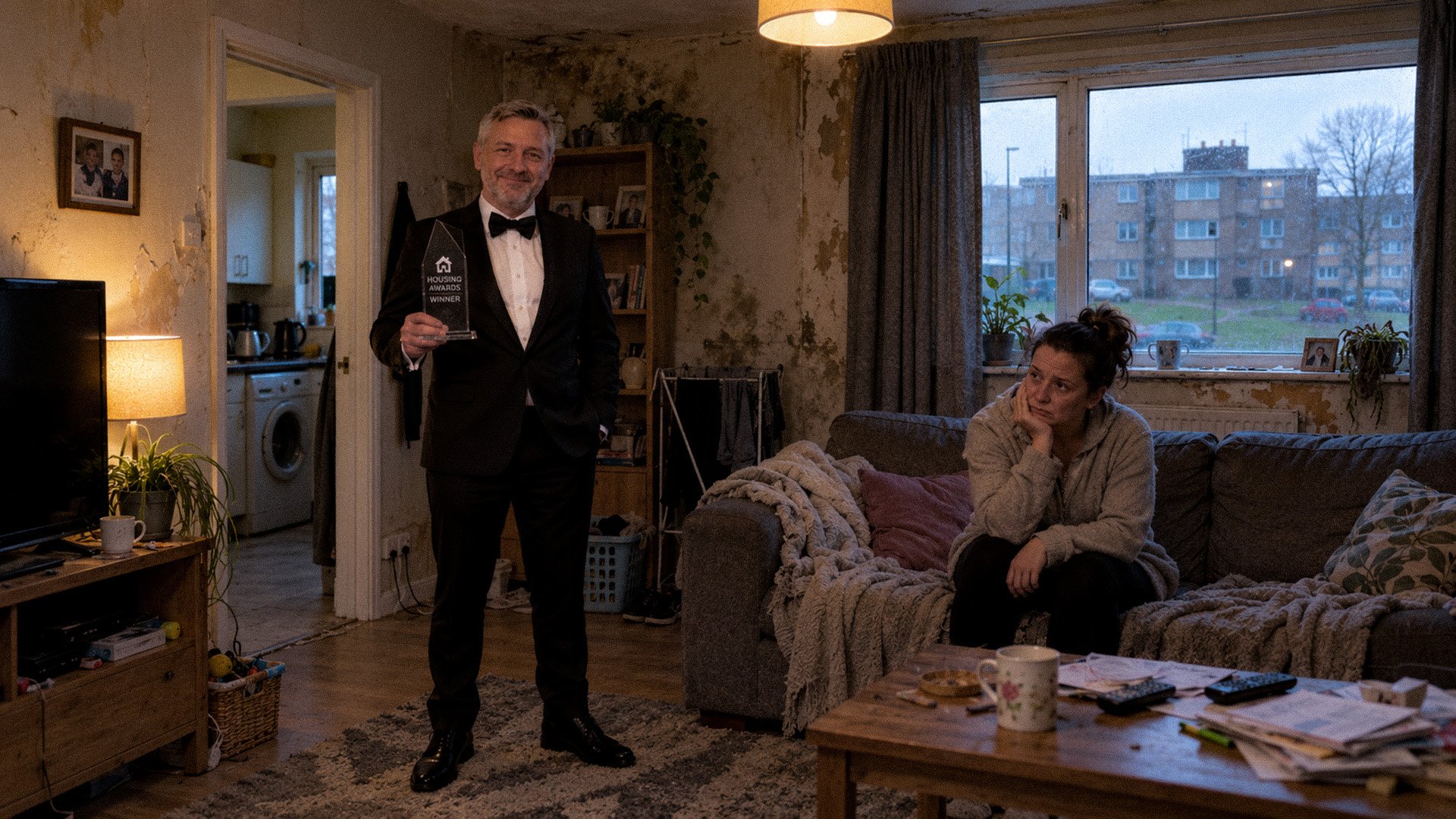
Last week I asked - Does Housing Have an Events Problem? This week I want to follow that with the awards circuit, because many of the same concerns appear again. The same relatively small professional circles, the same organisations, and of course the same familiar faces. The same people appearing as entrants, winners, judges, speakers, advisers and suppliers. And that creates a problem when due diligence is weak.
If claims are accepted without proper scrutiny, if evidence is not checked, and if someone with a patchy record of accuracy (and dare I suggest integrity) can have their assertions repeated and rewarded as fact, then an award starts to become something more than a harmless trophy.
Once something has been labelled “award-winning”, that description follows it into presentations, tender processes, consultancy pitches, websites, LinkedIn profiles and sales conversations. It can help one product, one initiative or one individual get ahead of another.
That matters if the award itself was based on claims nobody properly checked.
And it matters for another reason. Every weakly evidenced award, every questionable win and every piece of unverified hype does not just damage the reputation of the awards body. It diminishes the genuinely impressive achievements being recognised alongside it.
The people who have actually done the work deserve better than to have their recognition diluted by a system that may be too willing to accept the right story from the right people in the right room.
So this is not a blog about why housing awards are bad. It’s about what happens when the same people, moving in the same circles, pat each other on the back, celebrate and laud each other, while those genuinely driving good practice across the sector are overlooked through a lack of recognition. It is about what happens when the awards system stops properly distinguishing between genuine achievement and good publicity.
And by the end of this blog, I hope we can start to see exactly why that distinction matters.

Continued apologies, continued failures
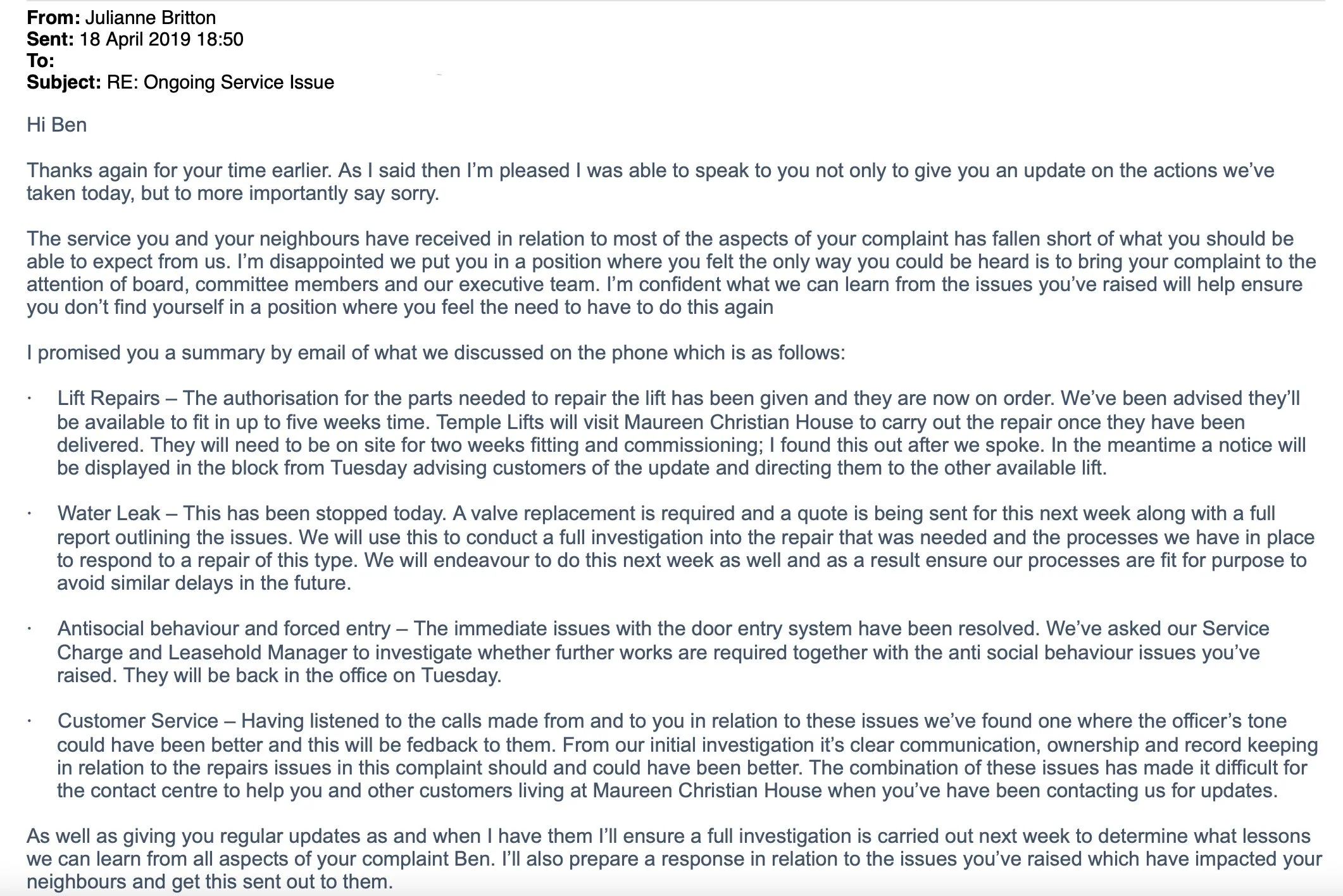
On 18 April 2019, I received an email from GreenSquare’s then Head of Customer Services, Julianne Britton. I should be clear that Julianne no longer works for GreenSquareAccord. I always thought of Julianne as a good egg. I spoke to her numerous times and worked with her in an attempt to resolve some of the issues we were experiencing. The issues covered in that email will sound painfully familiar to anyone who has followed what has happened here since. Lift repairs, a water leak, antisocial behaviour, forced entry into the building and failures in customer service.
Julianne did not try to dress it up. She wrote: “The service you and your neighbours have received in relation to most of the aspects of your complaint has fallen short of what you should be able to expect from us.” She went further. In relation to the water leak, she said GreenSquare would carry out a full investigation into what had happened and “ensure our processes are fit for purpose to avoid similar delays in the future.” When she turned to customer service, the words were equally clear: “From our initial investigation it’s clear communication, ownership and record keeping in relation to the repairs issues in this complaint should and could have been better.” She finished by promising that lessons would be learned.
That was 2019.
The point is that seven years after GreenSquare said it would learn from failures around repairs, communication and ownership, those same themes were still sitting among the main reasons residents were complaining.
Now jump forward seven years. In May 2026, following another complaint, this time involving our attempt to report a communal fire alarm problem, GreenSquareAccord wrote: “I do not consider the overall handling of the contact provided sufficient reassurance or clear ownership of the issue.” In the final findings they went further, stating that “the overall handling of the contact did not provide sufficient reassurance, coordination, or visible ownership of the issue whilst the communal fire alarm concerns were being reported.”
Read those words again. In 2019 it was communication and ownership that should have been better. In 2026 it was communication, reassurance and visible ownership that were still failing. Different complaint. Different staff. Different year. The same organisation describing remarkably similar failures.
And this is not simply my experience being presented as evidence of a wider problem. GreenSquareAccord’s own published performance figures tell us that the same issues continued to dominate complaints. In January 2025, 55% of complaints were attributed to delays or service failures, 21% to communication or information and 14% to incomplete action. A year later, delays and service failures were still 37% of complaints, communication or information 19% and incomplete action 9%. By February 2026, communication complaints were back up to 22%, with delays and service failures at 35%. In March, delays and service failures still accounted for 34% and communication or information for 22%.
I am not suggesting there has been no movement in those figures. There has. But that is not the point. The point is that seven years after GreenSquare said it would learn from failures around repairs, communication and ownership, those same themes were still sitting among the main reasons residents were complaining. And in 2026, GreenSquareAccord was still writing to residents acknowledging that it had failed to provide clear ownership, reassurance and communication around an urgent safety issue.
That matters for what comes next, because somewhere between those two apologies came the transformational language, the training exercises, the publicity, the case studies and, eventually, the awards. If we are going to celebrate transformation, reward it and then allow those awards to become evidence of success, we first have to ask a very basic question.
What actually transformed?
Then Came the Training, the Claims and the Awards
Following the merger of GreenSquare and Accord, I spent a relatively short and insignificant period serving on GreenSquareAccord’s customer panel. It wasn’t long however for me to conclude that the whole thing was little more than a tick-box exercise, and a way of perhaps silencing a vocal critic. I asked some difficult questions and was eventually removed for allegedly breaching a contract I had never seen nor signed. No evidence of that alleged breach was ever provided to me.
Around the same period, Steve Hayes arrived at GreenSquareAccord from Citizen Housing. Steve and I have a patchy history, although I want to make something absolutely clear. I have never met the man and I have never spoken to him. What I have done repeatedly is challenge claims and statements to which he has attached his name, particularly where those claims concern GreenSquareAccord and the experiences of its residents.
The issue is what happened when claims about its success began travelling beyond GreenSquareAccord and into the awards circuit.
A significant part of the communications strategy during Hayes’s tenure was about positioning GreenSquareAccord and its senior leadership as thought leaders. There were blogs, articles, LinkedIn posts, conference appearances and awards. Hayes brought with him extensive connections across housing communications, including organisations such as the Chartered Institute of Housing and Inside Housing, and GreenSquareAccord became considerably more visible within that relatively small professional circle. From my side of the fence, through the GreenSquareAccord Residents Support website, I continued doing what I had already been doing. I looked beyond the publicity and asked whether the resident experience matched what was being presented publicly.
GreenSquareAccord did not always appreciate that scrutiny. What followed included legal action against me and a long-running dispute about what I was publishing. I have written extensively elsewhere about that history, including the court proceedings and what I regard as inaccurate allegations made about me, and I am not going to rerun all of it here. It matters to this story only because it establishes something we are going to come back to repeatedly. Claims must be supported with evidence. When somebody makes a claim, particularly one that is going to be repeated by other organisations as fact, somebody ought to check it. It shouldn’t fall to me!
Which brings us to The Trials of Mrs Tranter.
Mrs Tranter began as an internal GreenSquareAccord training exercise. GreenSquareAccord has since confirmed that it was created in-house, using its own material and involving contributions from colleagues across the organisation. More than 650 colleagues eventually took part. The exercise itself may well have had value as staff training. That is not the issue I am raising here. The issue is what happened when claims about its success began travelling beyond GreenSquareAccord and into the awards circuit.
One of the headline claims was that complaints had fallen by 43% since its launch. Another was that the work had been “praised by the Housing Ombudsman”. Those are powerful statements. Attach them to an innovative training programme and you appear to have something quite remarkable. A training intervention comes along, complaints fall by almost half, and the Housing Ombudsman praises the results. You can understand why an awards judge might be impressed.
Except that, once questions were asked, the story became rather more complicated.
GreenSquareAccord subsequently explained that the 43% figure represented a fall in Stage 1 complaints from 597 in March 2025 to 340 in December 2025. Crucially, it also acknowledged that Mrs Tranter was only one element of wider training and improvement work. In other words, the figure demonstrated that complaint numbers fell between two selected months. It did not demonstrate that Mrs Tranter caused that reduction.
Yet a commercially adapted version is now associated with Creative Bridge, a for-profit business, and Steve Hayes is using Mrs Tranter as part of his own consultancy credentials
The Housing Ombudsman claim also required clarification. The complimentary wording being relied upon related to GreenSquareAccord’s wider complaints performance. It was not, according to Sophie Atkinson, Executive Director of Governance, the Housing Ombudsman independently assessing The Trials of Mrs Tranter and declaring the exercise a success.
And something rather interesting then happened. Those stronger claims began disappearing from Creative Bridge promotional material. The wording was softened. Yet by then Mrs Tranter had already entered the awards machine and accumulated the sort of recognition that can subsequently be presented as independent validation.
Four Gold awards followed.
This is where an internal training exercise starts becoming something else entirely. The work originated inside a not-for-profit housing association. GreenSquareAccord has confirmed there was initially no formal legal agreement governing its commercialisation. It has subsequently asserted its intellectual property in its own materials and has even offered to provide its version free of charge to other not-for-profit housing providers. Yet a commercially adapted version is now associated with Creative Bridge, a for-profit business, and Steve Hayes is using Mrs Tranter as part of his own consultancy credentials. His new website describes it as the engagement campaign “I created” and claims that 12 housing associations have now adopted it.
That is quite a journey. From an internally created GreenSquareAccord exercise, through claims of dramatic complaint reduction and Housing Ombudsman praise, into multiple Gold awards, commercial rollout and now personal consultancy credibility.
None of that automatically means Mrs Tranter has no value. What it does mean is that the evidence supporting the transformation being claimed deserves considerably more scrutiny than it appears to have received.
Because before we start handing out Gold awards, creating commercial reputations and allowing the words “award-winning” to influence future purchasing decisions, there is a very basic question that somebody should have asked.
Did anyone actually check the claims?

Can These Claims Be Taken at Face Value?
It is easy to become sceptical of somebody’s claims when previous claims have repeatedly required scrutiny. I want to use this section to explain why, when Steve Hayes makes a claim, I believe it needs to be checked rather than simply accepted at face value. As previously stated, I have never met Steve Hayes and I have never spoken to him, but through subject access requests I have obtained emails and correspondence showing what he was saying about me behind the scenes. I have previously published much of that material and I will provide links alongside this blog. If anybody wants to challenge what I am saying here, ask me for the evidence. I have the receipts and I am perfectly happy to show them. This is a good place to start.
Take the wider pattern. Steve Hayes made allegations about me to the police, allegations that were ultimately dropped when there was no evidence to support them. He contacted Inside Housing to check whether I was on the guest list for an event because, as he put it, my presence would make it problematic for him to appear as a speaker. He then used relationships with former colleagues at the Chartered Institute of Housing and contacts around Four Million Homes to make claims about me and to influence whether I could attend or participate in sector events. Internal emails later showed that these exclusions were being celebrated when they succeeded.
“I have not reviewed any claims regarding the reduction in complaints being solely attributable to the Mrs Tranter case study. This would not be the case.”
Sophie Atkinson, Executive Director of Governance
In my view, those interventions were not based on evidence but on false or unsupported claims, amplified through a network of professional relationships with organisations that also had commercial relationships, sponsorship needs and membership interests within the sector.
There was also the email exchange with Matt Baird from the Social Housing Roundtable, where Baird distanced himself from me and Hayes responded in the context of GreenSquareAccord potentially providing work, with Hayes positioning himself as someone able to reach the people who could approve purchase orders. That is why I keep coming back to the same point. When claims are being made by somebody with access, influence and commercial relationships across the same small network, those claims cannot simply be accepted at face value. They need evidence, they need scrutiny and they need independent validation.
That brings us straight back to The Trials of Mrs Tranter. GreenSquareAccord’s own Executive Director of Governance, Sophie Atkinson, eventually made the position remarkably clear. On the claim that complaints had fallen by 43% because of Mrs Tranter, she wrote: “I have not reviewed any claims regarding the reduction in complaints being solely attributable to the Mrs Tranter case study. This would not be the case.” She went on to explain that the reduction was attributable to “a large number of changes” and that Mrs Tranter was “just one element” of a wider customer service training programme.
The Housing Ombudsman claim also became rather less impressive once somebody actually asked what it meant. Atkinson explained that the wording appeared to have been abbreviated to “praised by the Housing Ombudsman” in media reports, while the actual Ombudsman quote related to GreenSquareAccord’s wider complaints performance rather than Mrs Tranter itself. That distinction matters. Saying the Housing Ombudsman praised your complaints performance is one thing. Allowing that wording to become attached to a particular training product gives an entirely different impression.

Extract from Sophie Atkinson email - 26th August 2026
GreenSquareAccord and Creative Bridge also reviewed how the project was being described. Creative Bridge confirmed that the content would be edited so that neither Creative Bridge nor any individual associated with it would be referenced as the original creator of the product. GreenSquareAccord separately asserted its intellectual property rights over the Mrs Tranter name, photographs and materials, and confirmed that Creative Bridge had accepted that position. Again, these are not insignificant little changes. They are exactly the sort of details that proper validation is supposed to establish before claims become accepted fact.
So I contacted the organisations handing out the awards.
Communicate magazine told me that its submission did not contain the 43% complaints reduction claim. It also said that Mrs Tranter had been presented to its judges as having been developed entirely in-house by GreenSquareAccord. Its publisher, Andrew Thomas, told me that having reviewed the concerns I raised, he did not believe they called into question the basis on which those particular awards had been judged. That is useful information because it tells us that not every award submission contained the same claims, and we should not pretend otherwise.

Extract from Andrew Thomas email - 1st September 2026
Annette Wade‑Clarke, Head of Membership and Marketing at The Institute of Leadership gave a rather different insight into how these things work. It told me that nominations are “accepted and considered in good faith” and that recognition is based on “the information available to the judges at the time”. It would not provide the submission or disclose the information the judges relied upon.
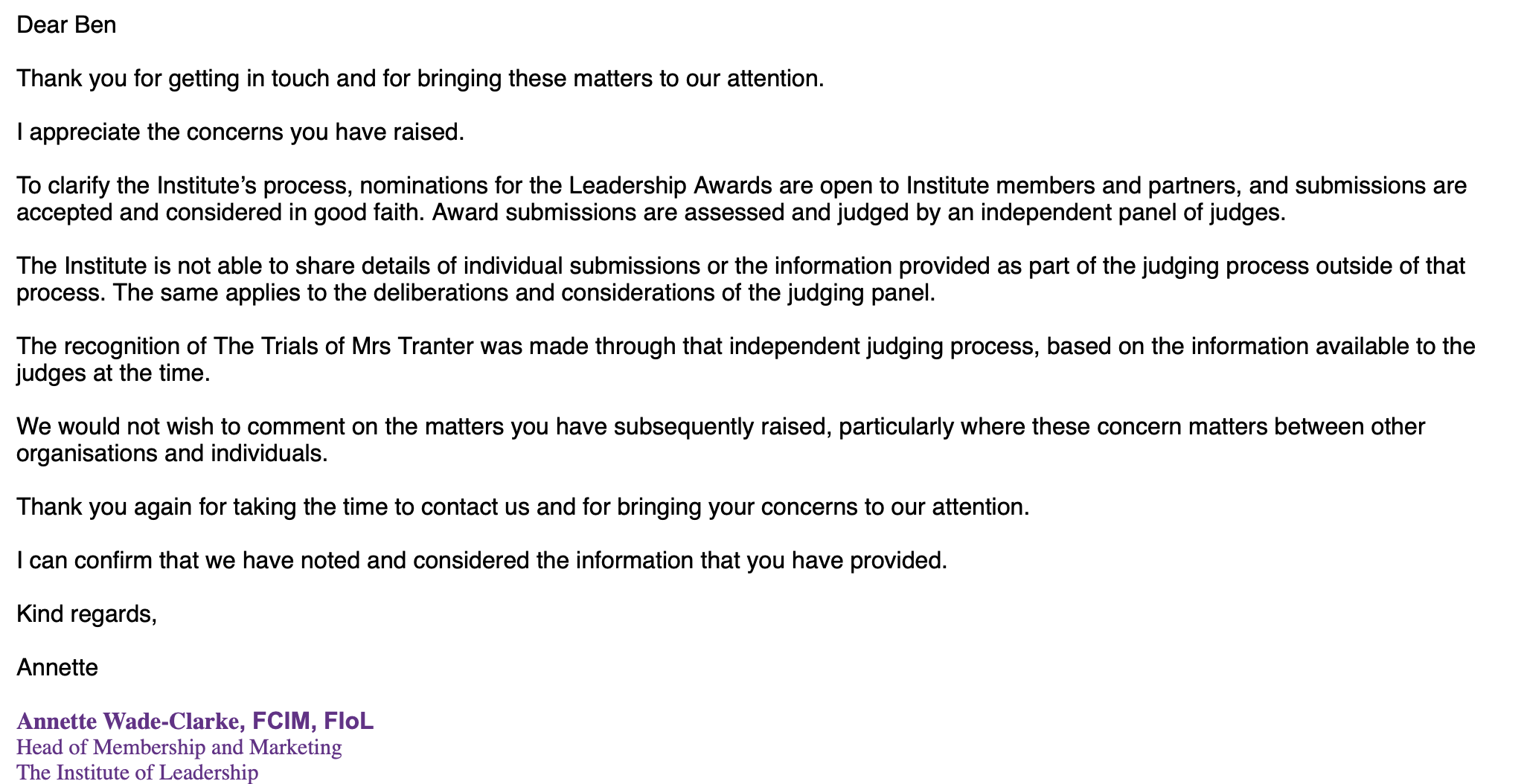
Extract from Annette Wade‑Clarke email - 2nd September 2026
And this, for me, gets to the heart of the problem.
There is an assumption when somebody wins a supposedly prestigious award that somebody has checked. That somebody has looked beyond the submission, tested the claims, asked for the evidence and established that what is being celebrated is actually true. Yet “accepted in good faith” is not validation. Judging something on the information submitted to you is not the same as independently checking whether that information is accurate.
That becomes particularly important when the award itself then acquires commercial value. The words “award-winning” do not stay inside the ballroom on the night the trophy is handed over. They appear on websites, LinkedIn profiles, consultancy pitches, tender documents and sales material. They become evidence of credibility. They help sell products and people.
So before we allow an award to become validation, perhaps the award itself needs validating first.
The Problem With Familiarity and “Good Faith”
Steve Hayes, who promotes himself as a communications & reputation consultant, has connections across the housing communications and awards circuit. On his own website he lists himself as an awards judge for the ICE Awards and the IoIC Awards, a keynote speaker at the IoIC Festival, a Fellow of the Institute of Internal Communication, a member of the advisory board for the National Housing Federation’s Communications and Influencing Conference, and chair of the advisory board for the Inside Housing Communications Conference. He has also worked within the Chartered Institute of Housing and has long-standing relationships across the same relatively small communications network.
Communicate magazine has told me something important as well. Its publisher said that the submission judged by them did not contain the 43% complaints reduction claim and that the work had been presented as having been developed entirely in-house by GreenSquareAccord. That distinction needs to be preserved because it shows that different awards may have been judging different claims. It would be wrong to imply that every award body received or relied upon the same information.
But that only strengthens the wider question. What exactly was each award body judging? What evidence did each one receive? What did they verify independently? What was accepted on trust? And when an award later becomes part of somebody’s commercial reputation, consultancy pitch or sales proposition, how confident can the public or a procurement team be that the word “award-winning” represents independently established success rather than simply a strong submission accepted in good faith?
When submissions are accepted “in good faith”. If the person making the claims is already known, trusted and embedded within the same professional circle, then familiarity itself can lend credibility before the evidence has been independently tested.
Lest we forget, Steve Hayes’s role at GreenSquareAccord has now ended, whether through redundancy, wider cost-cutting, or amid the reputational damage left behind during his tenure.
That is why the question is not whether these people know each other. In a small sector, of course they do. The question is whether the awards process is robust enough to separate reputation and relationships from the actual evidence behind the claims being rewarded.
What Does It Cost to Win?
Who actually paid for all of this? Who paid the submission fee, the entry fee, the table, the travel, the accommodation, the food, the wine and all the other costs associated with attending and celebrating the awards? Was it GreenSquareAccord, Creative Bridge, or Steve Hayes himself? And given that The Trials of Mrs Tranter was created in-house by GreenSquareAccord, using its own staff, resources, design support and paid labour, who from GreenSquareAccord was actually there on the night being recognised and celebrated for that work? How does that sit with the way Steve Hayes now presents the initiative as something he created, with the credit increasingly attached to him personally rather than to the wider team and organisation that produced it?
Lest we forget, Steve Hayes’s role at GreenSquareAccord has now ended, whether through redundancy, wider cost-cutting, or amid the reputational damage left behind during his tenure.
Last week, when I asked whether housing has an events problem, one of the central questions was how much money is being spent moving the same people around the same circuit of conferences, exhibitions, dinners and networking events. Awards are part of that same ecosystem, and the costs do not stop at putting somebody in a room with a trophy.
Take the 2026 Internal Communications and Engagement Awards. The published fee was £320 for a first entry, £195 for subsequent entries, and £195 for entries from charities, NGOs and not-for-profits. Late entries attracted a further £125 surcharge per entry. That is before anybody has attended the ceremony itself. A Silver table for ten was £3,490 plus VAT, a Gold table £3,980 plus VAT and a Platinum table £4,650 plus VAT. There were also “Plus” packages running as high as £5,625 plus VAT, combining the awards dinner with tickets to the associated ICE Live conference.
The IoIC Awards follow a similar model. For the 2026 dinner at the Hurlingham Club in London, an individual member place was £340 plus VAT, a non-member place £405 plus VAT, and a table of twelve £3,795 plus VAT. The ticket included the drinks reception, three-course meal, wine and the evening’s entertainment. Again, that is simply the cost of being in the room. It does not include the time spent preparing entries, staff time away from their normal roles, travel, hotels, photography, PR, social media promotion or any of the other costs that surround being shortlisted and attending.
And this is where the argument from last week comes straight back in. One awards evening on its own may be relatively easy to dismiss as a reasonable business expense. One entry fee may not look excessive. One hotel room, one train ticket, one table. But housing does not have one awards ceremony. It has multiple awards, multiple categories, multiple entries, multiple tables and many of the same organisations appearing throughout the year. The same cumulative problem we saw with events applies here. A few hundred pounds becomes a few thousand, which becomes tens of thousands once the full annual circuit is taken into account.
You pay to enter, somebody judges the submission, and if successful there is another opportunity to spend thousands of pounds attending the evening where that recognition is formally handed out.
I am not suggesting that every housing association buys the most expensive table or enters every award available. What I am suggesting is that we need to start looking at the total cost rather than each individual invoice in isolation.
This is a sector that repeatedly tells residents that finances are under pressure, repairs have to be prioritised, services have to be reshaped and difficult choices have to be made. Against that background, it is entirely reasonable to ask how much is being spent entering awards, attending the ceremonies and celebrating the wins.
And there is another important distinction from the events debate. With an event, at least the stated justification is normally learning, networking or professional development. With an awards ceremony, a substantial part of what is being purchased is recognition itself. You pay to enter, somebody judges the submission, and if successful there is another opportunity to spend thousands of pounds attending the evening where that recognition is formally handed out.
That does not automatically make the recognition worthless. But once we have already established questions about how thoroughly some claims are validated, the cost becomes much harder to ignore.
If the sector is spending significant sums entering and attending awards, then residents are entitled to ask a very straightforward question.
What exactly are we getting back for the money?
Undermining the Award
Surely, in my opinion at least, and perhaps in many of yours, the point of an award is to recognise the contribution of staff and the positive impact they have had on the people they serve. In housing, that means residents and tenants. If you disagree, please do let me know, but surely that has to be the starting point.
Housing desperately needs good news stories. We have already seen awards ceremonies publicly challenged and boycotted by campaigners such as SHAC, the Social Housing Action Campaign. Nine years on from Grenfell, nobody has yet been prosecuted, many of the same systemic problems remain, and residents continue to move from one housing failure to another. At the same time, there is enormous pressure to build more homes. That matters, but simply building quickly and cheaply is not necessarily something to celebrate if we are creating homes that begin falling into disrepair within little more than a decade. I live in a building that is around 16 years old and is already suffering serious problems, while GreenSquareAccord continues disposing of stock it no longer considers viable.
So I understand the need to bring some praise and some glory back into housing. Where somebody is genuinely performing, providing best practice and producing measurable improvements for residents, that work should be recognised. I, along with many others I suspect, would be far more willing to accept the costs associated with awards if I knew that the recognition was going to somebody who had genuinely and demonstrably improved the state of UK housing.
The problem comes when that recognition is undermined by awards where serious questions remain about relationships, evidence, validation and what has actually been achieved. When entrants, judges, speakers, advisers and professional associates are all moving within the same relatively small circle, and when claims can apparently pass through that system without rigorous independent checking, the value of the award itself begins to diminish. It starts to look less like independent recognition of achievement and more like another revenue-generating part of the sector’s professional ecosystem.
And once again, we find money moving from not-for-profit housing organisations into the hands of commercial organisations under the banner of recognising excellence. That might be defensible where genuine excellence is being identified. It becomes much harder to defend when the evidence behind the recognition is questionable.
The Trials of Mrs Tranter does not therefore just raise questions about Steve Hayes, GreenSquareAccord and Creative Bridge, all of which I will look at properly next week. It raises questions about the value of the awards themselves. Because somewhere else at the same ceremony may be somebody who has genuinely driven proven, measurable improvements that have benefited thousands of residents. Their achievement deserves to mean something.
If an initiative with disputed claims and limited independent evidence can stand alongside that work carrying the same supposedly prestigious badge, then the genuine achievement is diminished too.
And that is why today I am asking whether housing has an awards problem.
How Many Awards Does Housing Need?
Again, rather than trawl through every award scheme myself, remember I am a one-man army here, unfunded and trying to highlight an issue that the sector itself should be readily examining. As such, I have employed the help of my trusty AI companion, which has done a little research and pulled together the following.
Before looking at the individual prices, an important caveat. There is no single register of housing awards, so the figures below are a documented minimum based on awards I have been able to verify publicly. They also exclude broader communications, leadership, property, construction and professional awards that housing providers routinely enter.
I can identify at least 13 housing-sector award programmes in 2025 and at least 14 taking place, or scheduled to take place, during 2026. That includes the Housing Innovation Awards, Northern Housing Awards, Housing Heroes, Women in Housing Awards, Unlock Net Zero Awards, Inside Housing Development Awards, CIH’s All-Ireland, Scotland and Welsh Housing Awards, TPAS awards and others. Some are free to enter. That does not make them free to participate in.
The published 2026 costs give an idea of the scale:
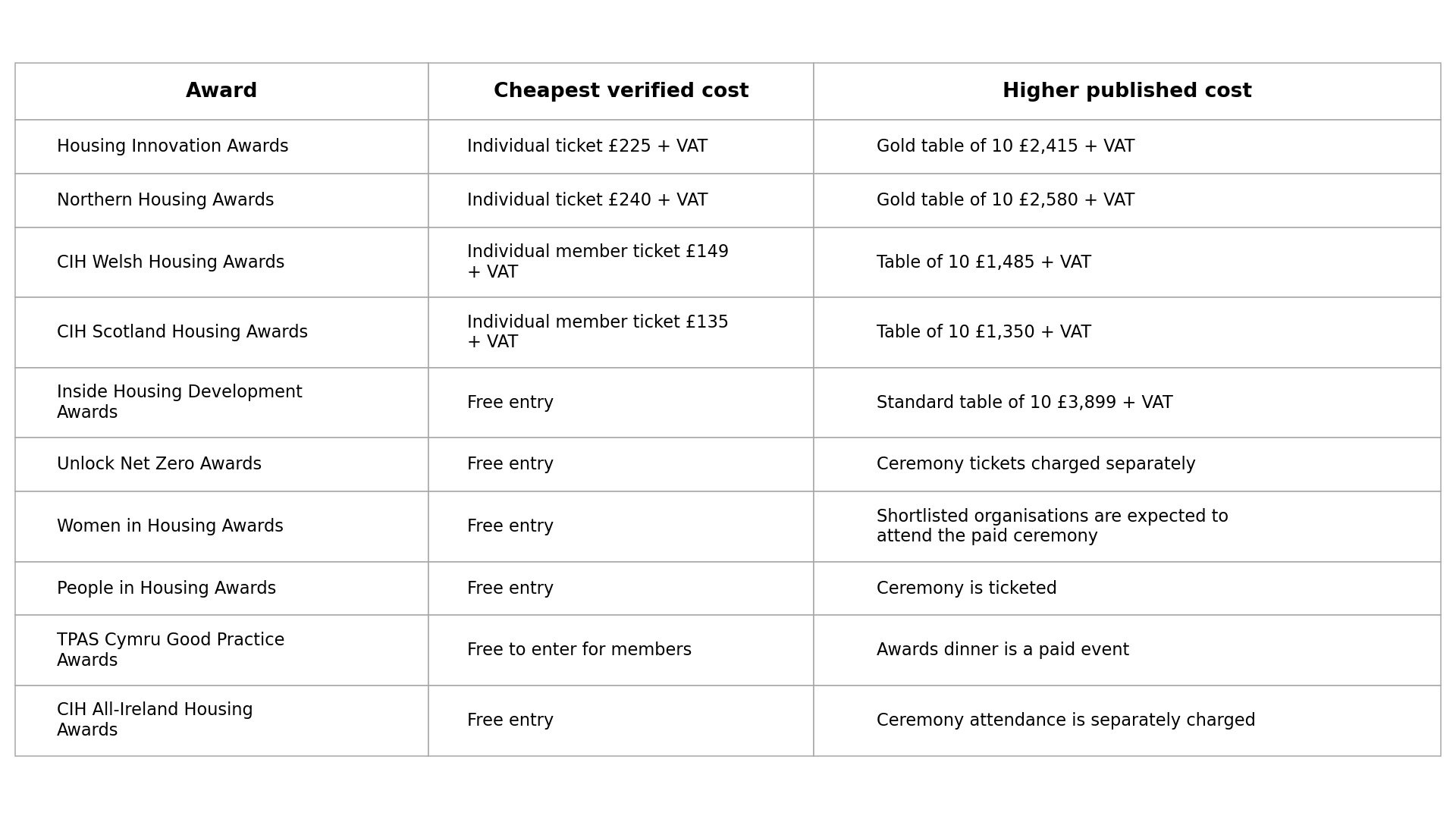
The Housing Innovation Awards charged £225 plus VAT for an individual ticket and £2,415 plus VAT for its top Gold table package. The Northern Housing Awards charged £240 plus VAT for an individual and £2,580 plus VAT for a Gold table of ten. CIH’s Welsh Housing Awards currently advertise individual tickets from £149 plus VAT and tables of ten at £1,485 plus VAT, while the Scotland Housing Awards start at £135 plus VAT for an individual and £1,350 plus VAT for a table.
At the other end, the Inside Housing Development Awards are free to enter, but being shortlisted comes with an expectation that organisations bring their teams to the ceremony. An individual early-bird ticket is £449 plus VAT, while the standard price for a table of ten reaches £3,899 plus VAT. Unlock Net Zero follows a similar model. Entry is free, but shortlisted organisations are expected to attend the ceremony, for which tickets are sold separately.
Free entry therefore needs treating with some caution. Women in Housing states explicitly that there is no entry charge but that shortlisted organisations are expected to bring their teams to the awards ceremony, where tickets and tables are sold. TPAS Scotland similarly says there is no cost to apply, while the ceremony itself is ticketed. CIH’s Scotland awards go even further in their own marketing, saying entry is free and that awards can “boost staff morale” and “validate your projects”.
Then there is sponsorship. CIH currently advertises sponsorship of an individual award at its Scotland Housing Awards for £3,495 plus VAT and sponsorship of the drinks reception for £3,750 plus VAT. Those packages include branding, advertising and direct visibility in front of attendees. The Welsh Housing Awards offer similar packages, including £3,495 plus VAT to sponsor an individual category and £3,750 plus VAT for the drinks reception.
And new awards are still appearing. The People in Housing Awards launched in the Midlands in 2026. Entry was completely free, and its first ceremony attracted 197 people from 50 organisations. Its commercial proposition to sponsors is particularly revealing because it advertises access to more than 100 “key decision makers within social housing”. That moves us beyond simply celebrating staff achievement and directly into the commercial value of putting suppliers in the same room as people with purchasing influence.
That is the point I keep coming back to. One £200 ticket is not the issue. One table costing £2,500 is not the issue. One free award entry is not the issue. It is the accumulation of them. At least 13 housing awards in 2025. At least 14 in 2026. Multiple categories. Multiple entries. Multiple tables. Multiple sponsors. Travel, accommodation and staff time on top.
Just as with the events circuit I looked at last week, each individual cost can be explained away. Put them all together and a much harder question emerges.
How much money is the housing sector spending every year celebrating itself?
The Procurement Problem
So it is clear that, alongside the events, we have identified another network of for-profit organisations benefiting from a sector largely made up of not-for-profit housing providers. We have also established that very little meaningful due diligence appears to go into at least some of the claims being rewarded. We have that in the award bodies’ own words. We have also established why claims made by Steve Hayes need to be interrogated rather than simply accepted at face value, and we have established how closely connected he is to the same relatively small professional circles in which these awards are judged, promoted and celebrated. It will not just be Steve Hayes, and it will not just be The Trials of Mrs Tranter, but this gives us a useful example.
So much of what I have learned about this sector has come from first-hand experience of GreenSquareAccord, its ever-changing senior leadership team, and the practices I have seen promoted and defended around it.
Again and again, we find a network of commercial organisations profiting from not-for-profit housing providers. That already leaves a bad taste in my mouth. But the procurement problem takes it further.
Imagine someone down the road has developed a genuinely innovative roofing tile. It improves insulation in winter, reflects heat in summer, incorporates solar capability and has the potential to transform roofing across the sector. It has been independently developed and properly researched. Now compare that with a cheaper, more familiar product that housing associations already know, already use and already buy, even if it has a poorer long-term track record. The innovative product may not have the money, the connections or the appetite to spend its time appearing at every event, buying tables, entering awards and working the same circuit. It therefore cannot plaster its website with phrases such as “award-winning”, “prestigious”, “sector-leading” or “recognised by industry experts”.
The inferior product, meanwhile, may have all of those badges.
That matters because awards create credibility. They influence perception. They can make one product look safer, more established and more trustworthy than another before procurement has even begun. If those awards themselves were based on weak evidence, limited checking or professional familiarity, then the award is no longer simply recognising achievement. It is interfering with the market.
That creates the same closed loop we have already seen elsewhere. The same people move within the same circles, recommend each other, celebrate each other and give each other access. Meanwhile, new ideas, new suppliers and new people struggle to get into the room.
Housing is already deeply flawed and desperately in need of new thinking, new leadership, new money and, frankly, fresh blood. Yet the structures around events and awards risk protecting familiarity rather than rewarding genuine innovation.
Perhaps, dare I suggest it, we do not need dozens of housing awards. Perhaps we need one serious, properly scrutinised housing award system where claims are checked, conflicts are declared, evidence is tested and the people being recognised can genuinely demonstrate what they have delivered.
Procurement should be robust enough to stand scrutiny. If the only way to get in front of CEOs, decision-makers and procurement teams is to play the game, attend the events, pay for the awards and collect the badges, then we have already lost sight of what procurement is supposed to achieve.
And residents may never even see this happening. That does not make it acceptable. Housing providers should be judged on their actions and their outcomes, not on the number of trophies sitting in reception.
Yet residents are the ones ultimately funding the not-for-profits, and more of that money is flowing into events, awards and the wider commercial ecosystem built around them.
So, I end this section where I began the blog.
Does Housing Have an Awards Problem?
If any of you know me and the work I do through my own platform, The Housing Sector, you will know that honesty and transparency are at the heart of it. So when I ask whether housing has an awards problem, the answer seems abundantly clear to me, and I suspect it will seem equally clear to the thousands of residents and tenants across the country living in homes that still fail the most basic test of being warm, safe, dry and affordable. Yes, housing has an awards problem.
The other side of that coin is important. There are people who genuinely improve services, support residents and deliver something better than what came before, and those people deserve recognition. Yet we undermine the value of that recognition when supposedly prestigious awards can be handed out without the scrutiny we should expect, within professional circles where entrants, judges, colleagues, associates and friends repeatedly cross paths. When one person wins four awards and the response from within that same echo chamber is effectively, “Wow, you really cleaned up,” the publicity amplifies the award, the award amplifies the individual and the cycle continues.
What we need is more people willing to challenge that cycle. Too much of the sector plays to the audience. Organisations depend on memberships, sponsorship, advertising, consultancy or access, and that inevitably makes it harder to upset the people paying the bills. That is the crucial difference with what I am doing here. I am not writing this because I expect to make money from it. I am not selling tables, memberships, entries or consultancy off the back of it. I am raising it because I believe the question needs asking. I am rating it because I have ‘skin in the game’.
And the question is bigger than whether somebody deserved a trophy. These awards have become part of a commercial ecosystem. They create procurement opportunities, put suppliers and decision-makers in the same rooms and move money from not-for-profit housing providers into commercial organisations. The failure to properly interrogate the claims surrounding The Trials of Mrs Tranter, Steve Hayes, Creative Bridge and GreenSquareAccord, particularly where the organisations awarding recognition have themselves acknowledged the limits of what was checked, should be enough for us to stop and ask whether the system is doing what we think it is doing.
If housing wants residents to trust it, then transparency, honesty and openness cannot simply be words attached to another corporate strategy. Sometimes that means stepping away from practices that have become normal simply because everybody else is doing them. The awards circuit, much like the events circuit, has ballooned beyond reasonable context.
So perhaps we strip it back. Perhaps we have an awards system that genuinely champions best practice, celebrates proven success and promotes the people who have actually earned recognition. Because when questionable achievements are elevated alongside genuine ones, the people doing exceptional work are diminished too. Their successes become lost beneath the glitz, glamour and gloss of the PR machine.
Housing has spent long enough celebrating how good it says it is.
As a resident/tenant/customer can we please have more substance and a lot less false PR. And again, as a GreenSquareAccord resident with a long history of dealing with Steve Hayes and the organisation around him, I can say this clearly; the behaviours and practices I have witnessed have not enhanced the reputation of the sector, they have brought shame to it. The GSA Way is looking increasingly like the ‘Way’.
Right to Reply
The Institute of Leadership
The Institute of Leadership responded to my right-to-reply request by confirming that award submissions are accepted and considered “in good faith” and that entries are assessed through an independent judging process.
Crucially, the Institute also confirmed:
“The Institute does not independently verify or investigate every claim, assertion or piece of evidence contained within an award submission.”
It went on to explain that the judging process is based on the information available to the panel as part of the submission and the criteria for the relevant award category.
The Institute said it could not disclose the details of individual submissions, the information provided by entrants or the deliberations of the judging panel because of confidentiality. It also made clear that it would not comment on subsequent matters involving the initiative, the organisations or the individuals concerned, which it considers outside its role in administering the awards.
I have included this response because it directly clarifies the Institute’s process and, in my view, underlines the central point raised in this blog: an award can carry significant reputational and commercial weight even where the claims contained within the submission have not been independently verified.