
When the Sector’s Own Code Meets Reality
The National Housing Federation has again published its Code of Conduct, setting out the standards of behaviour, culture and accountability it believes should apply across the social housing sector. It is aimed at the people who work for and represent housing associations, including staff, board members and residents involved in their work, and is intended to promote better decision-making, stronger governance, greater accountability and, ultimately, better outcomes for tenants and residents.
It is not legislation, and it is not automatically binding on every housing association; it is a model Code intended to be adopted and adapted. But that does not make its standards meaningless — particularly when the Federation itself presents them as the behaviours people working in and around social housing should aspire to.”
On paper, it is difficult to argue with any of that.
But like so much I have discovered during the past ten years of working with residents and trying to make sense of things that, at times, people would seemingly rather you did not make sense of, there remains a huge gap between what the sector says, what it presents publicly and what is actually delivered.
That gap has consequences. It affects tenants and residents, communities, governance and trust. It damages the reputation of organisations and senior leaders, while frontline staff are often left dealing with the fallout. It undermines resident engagement, resident empowerment and the support networks that are supposedly there to make the sector more open, accountable and responsive.
Once again, I find myself reading the standards the sector says it believes in and comparing them with what happens when those standards are actually tested. And once again, the distance between the version of social housing we present and the version people experience appears uncomfortably large.

What the Code Actually Says
This is where the National Housing Federation’s Code of Conduct becomes interesting, because the language is not particularly vague. Under professional relationships, it states:
“You must welcome constructive challenge and respectful disagreement from others, and offer challenge to others in a constructive and respectful way.”
That is a fairly clear expectation. Challenge is not something to be managed away simply because it is uncomfortable. Respectful disagreement is not supposed to become a problem simply because somebody dislikes what is being said.
The problem with terms such as “constructive” and “respectful” is that they are subjective. Too often, legitimate anger is treated as unacceptable simply because it makes someone uncomfortable — yet I find it far more offensive that residents can live in unsafe, unaffordable homes and then face an overbearing response, or even threats of legal action, from organisations that call them customers.
The same applies when decisions are challenged:
“You must be prepared and able to offer residents a clear explanation for actions or decisions you take, especially where these directly affect them.”
And then, perhaps most importantly for everything that follows:
“You must respond constructively to feedback about your actions, decisions and performance, by whoever this is provided.”
By whoever this is provided.
Not only when it comes through a resident panel. Not only when it arrives through an approved engagement structure. Not only when the person asking is convenient, compliant or already inside the room.
The Code goes further. If somebody becomes aware of a problem requiring action, they “must not ignore, conceal or minimise the issue”. It also requires openness to learning from resident scrutiny, complaints and other feedback.
And boards and senior staff are expected to promote an organisational culture founded on “openness, respect and accountability to residents”.
Taken together, it is remarkably simple.
Listen to challenge. Explain decisions. Respond to feedback. Do not minimise problems. Learn from scrutiny. None of that is radical. In fact, it is exactly the kind of behaviour the sector repeatedly tells us it wants. The more difficult question is what happens when somebody actually puts it into practice.
Difficult Questions Are Fine — Until You Ask Them
I could go back years and find examples of the gap between the language of openness and what happens when somebody starts asking uncomfortable questions. I do not need to. Some of the clearest examples are happening now.
Only recently I published an open letter raising questions of Birmingham City Council. There has been no response. It is worth mentioning, but this blog is not about Birmingham City Council (this one is). It is simply another recent example of how easy it remains for organisations to say nothing when the questions become inconvenient.
GreenSquareAccord is a much more significant example for me because I know the consequences of persistent challenge there better than most.
Its response to me over several years has included restrictions, legal threats and court proceedings. The escalation ultimately became serious enough for my experience to be raised in the House of Commons during a debate about Strategic Lawsuits Against Public Participation — SLAPPs.
I have written about that history separately, including the way the focus gradually moved away from the housing issues being raised and towards dealing with the person who would not stop raising them.
Read: SLAPPs — Ben Jenkins vs GreenSquareAccord
Now place that alongside the National Housing Federation’s new Code.
GreenSquareAccord Chief Executive Ruth Cooke sits on the National Housing Federation board. She therefore sits within the leadership structure of the organisation publishing these standards while simultaneously leading a housing association that has faced serious governance questions, regulatory scrutiny, repeated Housing Ombudsman findings and sustained criticism over the way it deals with challenge.
I am not suggesting that sitting on the NHF board makes Ruth Cooke personally responsible for every word of its Code. That would be ridiculous. I am asking something much more straightforward.
How comfortably does the behaviour I have experienced from the organisation she leads sit alongside a Code requiring constructive challenge to be welcomed?
How does years of restriction, litigation and escalation sit alongside a requirement to respond constructively to feedback?
How does that sit alongside a culture supposedly founded on openness and accountability to residents?
These are not difficult questions because they are complicated. They are difficult because answering them may be uncomfortable.

Who Actually Represents Residents?
That same problem has become increasingly visible in the debate around resident engagement. Over the last week I have been asking TPAS a simple question.
Who gave you consent to speak for us?
TPAS talks about reaching huge numbers of tenants, residents, shared owners and leaseholders. People connected with TPAS speak about representing large numbers of residents. One associate recently described how sometimes only “two or three” tenants may act as a proxy for “tens of thousands”. That statement should immediately raise questions about representation.
I have never given TPAS consent to speak for me. I have never asked TPAS to speak to my landlord about my interests. And I certainly never asked my landlord to use money collected from tenants and residents to fund somebody else to supposedly represent my voice.
This is why I have also questioned whether the current model is still fit for purpose. TPAS is funded through work with the housing sector while simultaneously occupying a position within the infrastructure supposedly helping residents to challenge that sector.
That does not automatically mean its work has no value. But it absolutely means questions about independence, funding, representation and consent are legitimate.
TPAS's latest accounts also show an organisation with significant financial resources: around £2 million in cash and approximately £1.5 million in net assets. Against that background, asking what residents receive, who is being represented and who actually authorised that representation is hardly unreasonable.
I publicly asked those questions and tagged TPAS Chief Executive Jenny Osbourne. I received no answer. What happened next is perhaps more revealing.
Engagement, or the Performance of Engagement?
I recently challenged another example of sector engagement involving Southern Housing.
My argument was simple. Formal engagement repeatedly reaches the people who are already engaged, already comfortable operating inside sector structures and already willing to attend panels, workshops and conferences.
The residents who may be most important to hear from are often somewhere else entirely. They are in complaint queues. They are underneath housing-association Facebook posts asking why their repair has still not been completed. They are posting angry TikTok videos. They are emailing executives. They are sitting in homes affected by damp, leaks, mould, failed repairs or antisocial behaviour. And increasingly, many of them have simply lost faith in their landlord.
Southern Housing responded to my criticism by explaining the different mechanisms it uses to gather feedback; panels, surveys, engagement hubs, Tenant Satisfaction Measures and comments on social media. But that wasn't really my question.
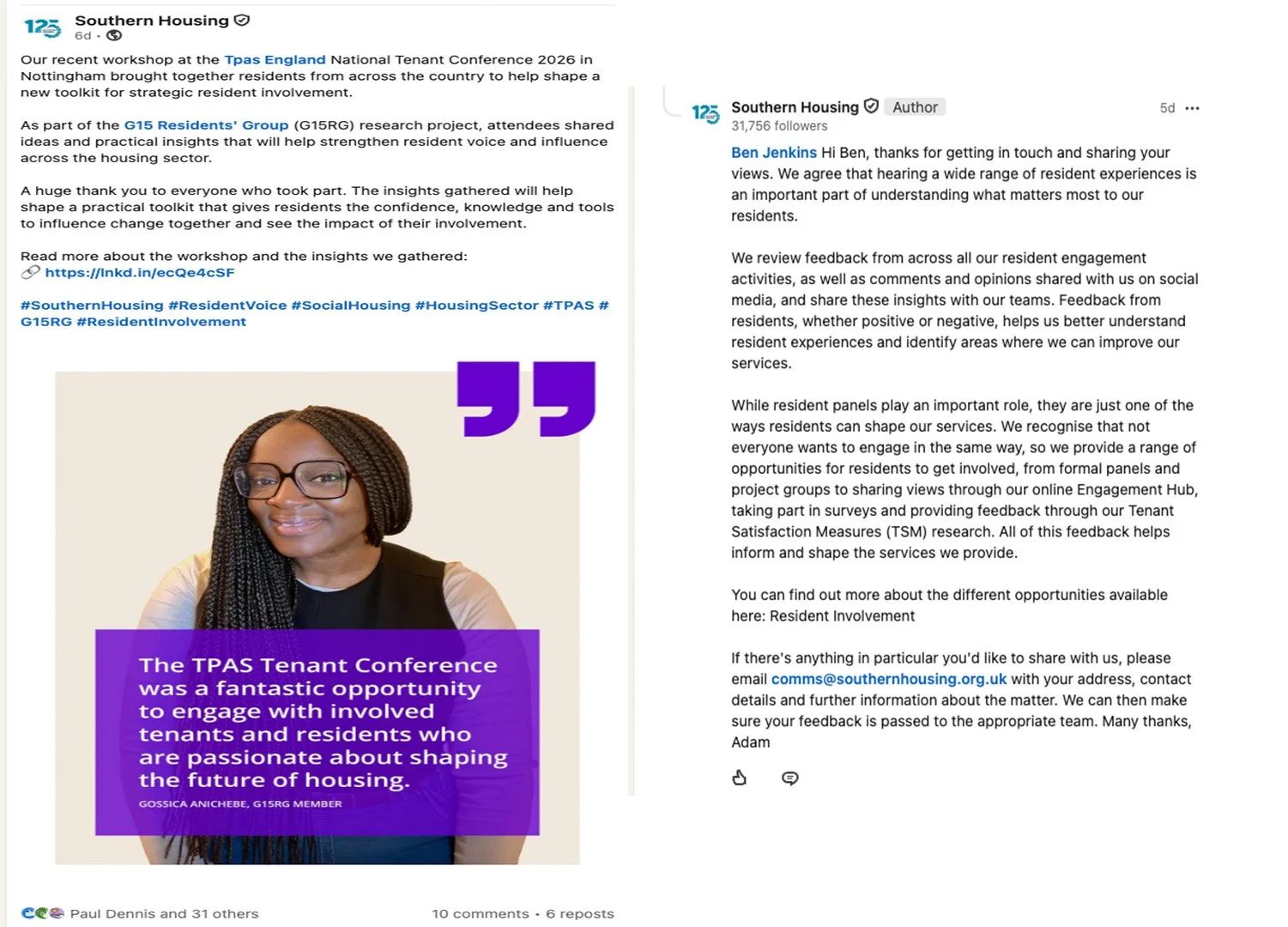
The question is what changed because somebody challenged you?
Listing engagement mechanisms is easy. Holding a conference is easy, and generate revenue. Creating another panel is easy. Producing another toolkit, strategy, survey or glossy report about resident influence is easy. The test of engagement is what happens when somebody tells you something you do not want to hear.
If the National Housing Federation genuinely means that feedback should be responded to constructively “by whoever this is provided”, then resident influence cannot be measured simply by the number of events held, surveys completed or people photographed sitting around a conference table.
Resident engagement should not be measured by how many opportunities you create for people to speak. It should be measured by what happens after they speak. Particularly when what they say is uncomfortable.

When Resident Voice Starts Behaving Like the System
There is another recent example I could name here. I am deliberately choosing not to.
For the record, I never mentioned them, tagged them or invited them into this discussion. They chose to insert themselves and, rather than answer the questions being asked, brought the death of their child and childhood cancer into a debate about consent and resident representation. Those experiences are real and deeply serious, but they are wholly unrelated to the point under discussion. Anyone applying even a basic level of emotional intelligence should be able to see that the two do not belong in the same argument.
The individual concerned appears increasingly determined to pull my criticism, my platform and my audience into their own public positioning. I am no longer connected with them and I have no interest in helping to increase their profile. As such their name is irrelevant, their position within the system however, is not.
They present themselves publicly as an independent resident advocate and have involvement across an extraordinary number of established sector structures; national tenant groups, a regional residents' panel, the Housing Ombudsman's Residents' Panel, Four Million Homes, TPAS and other organisations. There is nothing inherently wrong with any of that. But it illustrates something I increasingly think the sector needs to confront.
Look closely at some of the people repeatedly presented as “independent resident voices” and you can find the same individuals moving between landlord panels, Ombudsman structures, national engagement programmes and other sector-backed initiatives.
At what point does an independent resident voice become part of the institutional engagement system itself? And if those same people are then relied upon to validate that system, defend it from criticism and claim to represent much larger populations of residents, the question of consent becomes unavoidable.
This particular example is even more revealing because I have private correspondence showing a very different position from the one now being presented publicly.
I was previously told that tenants were being encouraged to believe they could only have a voice “via other people”. I was told that housing bodies were supporting groups rather than “listening to the tenants themselves”.
And I was told:
“The current crisis won’t be solved by people who exist in the same echo chamber.”
I agree.
The same person previously praised my podcasts, described my work holding landlords to account positively and warned me about the way the sector operated. Now that my criticism has reached TPAS and the resident-engagement structures with which that individual is associated, the response has changed dramatically.
Instead of responding to a straightforward opinion about consent, the discussion has become intensely personal.
Bereavement. Bullying. Personal trauma. And, extraordinarily, childhood cancer.
In one public post responding during this dispute, the individual wrote:
“Passive aggression is almost as ugly as childhood cancer.”
Childhood cancer is devastating, but it has no connection whatsoever to questions about consent, representation or TPAS; introducing it into this debate shifts attention away from the issue being challenged and onto the person choosing to make it personal.
This is a pattern I have written about before. It resembles the wider behaviour I have experienced when scrutiny stops being answered on its merits and instead becomes reframed around the character, motives or behaviour of the person asking the questions.
And there is another detail here that I find difficult to ignore.
Jenny Osbourne, Chief Executive of TPAS, was directly tagged in my public post asking questions about consent and representation. She did not answer them. Yet she did react to the subsequent post from a TPAS-associated resident defending that position. That contrast is difficult to ignore; direct questions about the legitimacy of the model go unanswered, while a highly personal response to those questions receives visible support.
Again, nobody has to agree with me. But surely the National Housing Federation's own standard provides a rather simple answer to what should happen next; respond constructively to the feedback. Answer the question.
Four Million Homes — Another Safe Space for Resident Voice?
My experience with Four Million Homes raises the same issue. I was invited to participate in one of its events. GreenSquareAccord then contacted the organisers. Following that intervention, my participation changed and I was told that I could contribute only through a pre-recorded video. I refused.
That incident leaves me with a question I still think deserves an answer. If an organisation exists to empower residents, what happens when a landlord objects to one of the residents you have invited? Who comes first, the challenging resident or the relationship with the sector supporting the programme?
This matters because organisations such as TPAS and Four Million Homes do not operate outside social housing. They operate within an ecosystem funded, commissioned and supported by the sector itself.
Again, that does not automatically make their work illegitimate, but it creates an obvious tension and it makes genuine independence absolutely essential.
There is also a structural problem with these organisations; they are often run by people with deep personal and professional ties to the sector itself. They are expected to challenge former colleagues, friends and familiar faces from the same conference and events circuit, while those same senior leaders often influence which organisations and resident voices are given access, legitimacy and a platform.
The same concern applies more widely. In my own experience, invitations involving the Chartered Institute of Housing were later withdrawn after intervention from people with existing sector relationships. When the people who need to be held accountable are also part of the network deciding who gets heard, who gets invited and who is deemed representative, the idea of independent resident voice starts to look deeply compromised.
Once resident engagement becomes dependent upon remaining acceptable to the organisations being challenged, it stops being independent challenge. It becomes controlled participation.
The sector appears far more comfortable with selected residents than with residents generally; the established panel members, the people who understand the language, attend the conferences, know the chief executives, engagement officers and Ombudsman staff, and gradually become familiar faces across the sector.
Many undoubtedly start with good intentions, but access brings relationships, relationships bring opportunities, and opportunities can bring status. Slowly, and sometimes without even realising it, the person who entered the room to challenge the system can become part of the system itself.
That does not make those residents bad people, but it does mean we should stop confusing participation with representation. Sitting on multiple panels does not create a wider mandate, attending national events does not confer democratic legitimacy, and being invited into the room does not give anyone authority to speak for everyone left outside it. If anything, the more someone is presented as a resident representative, the more scrutiny there should be over who they actually represent, how that mandate was obtained and how independent they remain.
The Code Is Not the Problem
The National Housing Federation's Code of Conduct is not the problem. Much of it is perfectly sensible. It asks people to welcome constructive challenge, listen to residents, explain decisions, respond to feedback, avoid minimising problems, learn from complaints and scrutiny, and promote openness, respect and accountability. The problem begins when those principles meet reality.
Ruth Cooke’s position on the National Housing Federation board makes this contradiction impossible to ignore. The organisation she leads has already been discussed here in the context of restrictions, legal action, governance concerns and parliamentary debate about SLAPPs. Against that background, the Federation’s insistence on openness, accountability and constructive challenge starts to look less like a standard being lived and more like one being published.
The Code says challenge should be welcomed, feedback should be responded to constructively regardless of who provides it, and problems should not be ignored, concealed or minimised. Those are clear expectations, yet they do not sit comfortably with the behaviour I have experienced.
And this is bigger than Ruth Cooke. The Federation itself says boards and senior staff should create cultures based on “openness, respect and accountability to residents”. Yet when I have asked questions of the National Housing Federation's own Chief Executive, Kate Henderson, I have not received answers. I was blocked instead.
Nobody is required to like me, and nobody is required to agree with me. That is not the point. If your own published standard says challenge should be welcomed, then your response to challenge cannot depend on whether you approve of the person asking the question. Otherwise the standard becomes conditional, and once that happens it starts to lose its meaning.
A Code of Conduct, credo or mission statement only has value if the behaviour around it reflects the principles written inside it. If the people and organisations closest to those standards ignore them when scrutiny becomes uncomfortable, contradict them in practice or fail to measure themselves against them, then the problem is not a lack of guidance — the guidance has simply become another slogan. This sector already has more than enough slogans. What it needs is measurable action, because if you cannot adhere to your own stated values and standards, you have already undermined the very thing you are asking others to believe in. It’s already broken.
Why Residents Have Lost Faith
This is why residents lose faith, trust and, increasingly, respect for the institutions supposedly designed to protect, empower or represent them. Residents are expected to follow every stage of the process, repeat evidence, use the approved channels and remain patient while complaints move through landlords, the Housing Ombudsman, the ICO and the Regulator of Social Housing.
Meanwhile, the organisations on the other side can fail to answer questions, redirect residents back into systems that have already failed them, restrict engagement, block critics, personalise disputes or simply remain silent. The gulf between residents and the sector is not growing because residents fail to understand the system. Increasingly, it is growing because they understand it only too well. They can see the difference between the values being published and the behaviour being practised, between genuine challenge and managed engagement, and between broad resident representation and the same small circle of approved voices appearing repeatedly at the same events and within the same structures.
We can also see when difficult questions are buried beneath arguments about tone, personality or process, and when accountability is applied far more rigorously to residents than to the institutions demanding it.
Answer the Question
You might not like what I say, the way I say it, or the conclusions I reach, and that is entirely your right. I genuinely do not care whether my questions are comfortable. What I care about is whether they are answered. I have had enough of the games, the structures and the endless language about engagement, accountability and resident voice that too often bears little resemblance to what residents actually experience. And perhaps more importantly, so have a majority of your so called ‘customers’.
I have already seen how quickly supposed allies can change once their own commercial interests are involved. People have endorsed my work to my face, only for subject access requests to later reveal them dismissing and distancing themselves from my actions behind the scenes, all while trying to secure a purchase order — something I experienced with the Social Housing Roundtable and Matt Baird, the ethical recruiter who perhaps values sponsorship more than ethics.
That is the uncomfortable reality for organisations claiming they want to challenge the sector while still depending on the sector for work. If your criticism has to stop the moment somebody needs a PO signed, then you are not independent; you are commercially constrained.
So answer the questions. If TPAS represents tens of thousands of residents, explain how that mandate works and where the consent comes from. If its Chief Executive can publicly support people defending that model, then she should also be prepared to answer direct questions about it.
If Four Million Homes exists to empower residents, explain what happens when a landlord objects to one of the residents it has invited to participate.
If housing associations genuinely welcome scrutiny, stop directing residents back into customer-service systems that have already failed them. And if resident representatives are genuinely independent, they should be able to withstand exactly the same level of scrutiny they expect housing associations and senior leaders to face.
The same standard must apply to the National Housing Federation itself. If it genuinely believes its new Code of Conduct matters, then the behaviour of the Federation, its board members and the organisations they lead needs to reflect it. Otherwise the Code does not close the gulf between residents and the social housing sector. It simply documents it.
Residents and tenants like me are not challenging the sector for the sake of it. We are doing it because our homes are unsafe, unaffordable and damaging to the lives of our families, children, elderly neighbours and wider communities. Yet while residents are dealing with those consequences, the sector continues to celebrate the events, the awards, the partnerships and the charitable gestures, even as the people it was established to serve are increasingly being failed.
That is the gulf between the sector and its residents. And when the response to challenge is defensiveness, dismissal or attack, that gulf only grows wider. The real question is not whether residents should keep challenging you. It is what you are prepared to do about the failures they are challenging you over.
The National Housing Federation’s Code of Conduct is important, but only if it is actually followed. And if it is not being followed by the Federation’s own leaders and by people sitting on its board, then why should anyone else take it seriously? Why should residents have any faith in it? Without that example being set from the top, it is just more empty rhetoric.
And that should matter to us all.