Does Housing Have an Events Problem? Part II
Two Summits the Sector Could Have Done Without
Earlier this month, I published a blog asking a simple question - does housing have an events problem?
At the time, I had identified more than 40 housing conferences, summits and awards ceremonies taking place during 2026. The total may already have passed 50. Many feature the same people discussing the same failures, sharing the same ideas and then moving on to the next stage, panel or drinks reception.
The problem is not that people meet. It is that activity is too often presented as impact. A full room, familiar speakers and a polished highlights video prove that an event happened; they do not prove that anything changed outside it.
Meanwhile, residents are repeatedly told that their housing providers face impossible financial choices. Tickets, travel, accommodation, food and staff time all cost money. It is therefore reasonable to ask what these events deliver, who benefits and where the measurable outcomes can be found.
Since publishing the first blog, I have posted it beneath promotions for forthcoming events. Most organisers have left the comment in place. I hope it has encouraged a useful discussion.
Then, on Sunday 13th September, I saw a LinkedIn promotion for the London Housing Summit, organised by David Stevenson through Regener8 Housing Consultancy and scheduled for 17 September. It followed the first Regener8 West Midlands Housing Summit, held in Birmingham on 4 June—exactly 15 weeks earlier.
David was promoting the London summit as an exceptionally meaningful and important event. So I asked what made it more meaningful than the dozens of other housing events already held that year, and linked to my earlier blog.
The comment was deleted.
I sent David a LinkedIn voice message asking why a reasonable question had been removed. If an event is publicly promoted in exceptional terms, asking what supports those claims is legitimate scrutiny—not a personal attack.
David replied and supplied his telephone number. He told me in forceful terms that I was not to leave negative comments about him online. My question had not been negative, but his apparent attempt to dictate where and how I could comment angered me. I called the number he had provided.
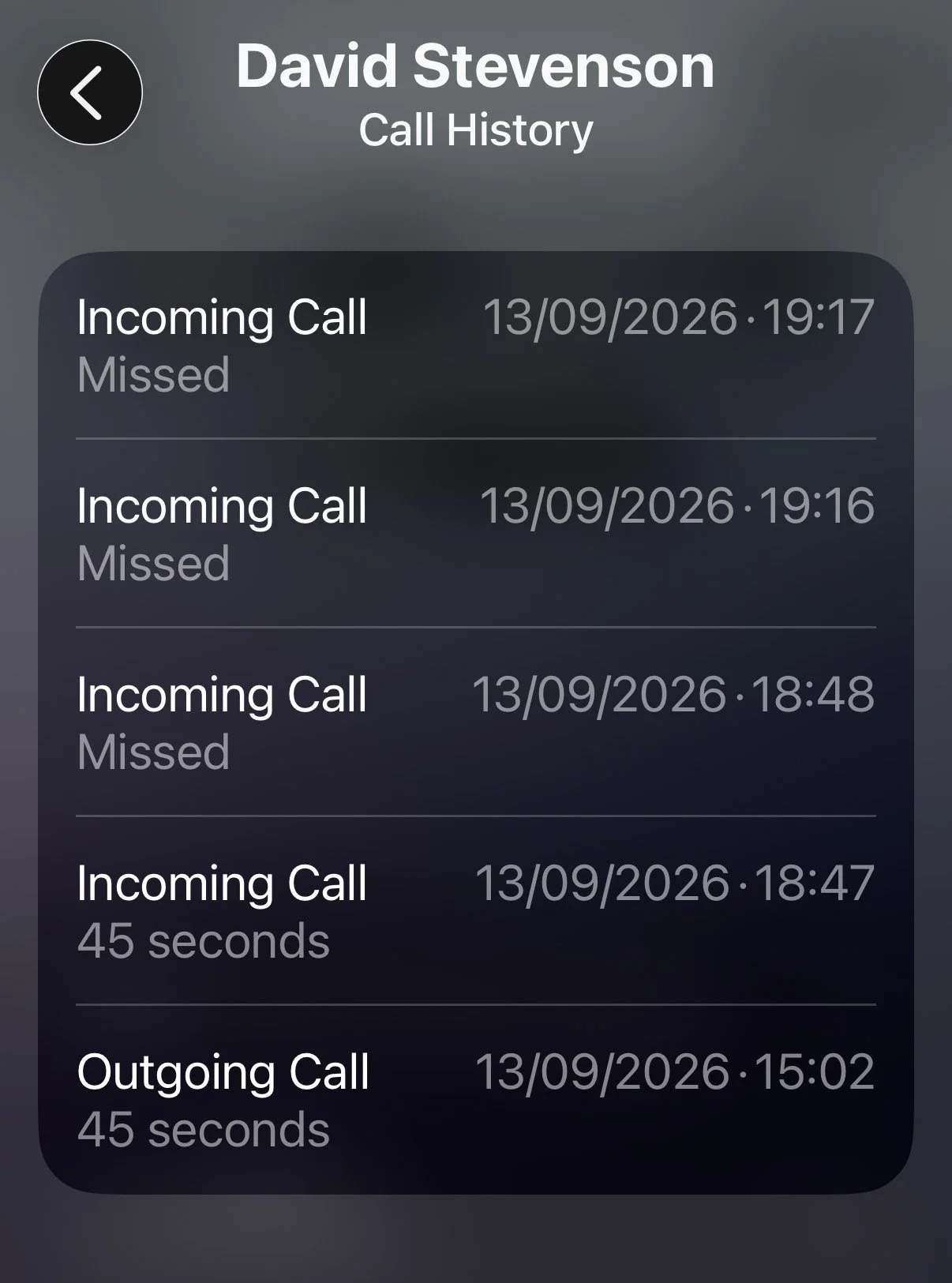
That was the only telephone call I initiated. The call log shows it began at 15:02 and lasted 45 seconds. David's tone was immediately confrontational. He challenged me for calling on a Sunday and continued telling me what I could and could not do. I ended the call because it was plainly going nowhere.
David then blocked me on LinkedIn. Comments and parts of the exchange were no longer visible to me. I made clear that there was no purpose in continuing a private argument and began examining David, Regener8 and the claims made for his two summits.
That should have been the end of our direct contact. It was not.
A Serious Housing Professional—or So It Appeared
On paper, David looked like somebody whose claims deserved to be taken seriously. His published history described more than 30 years in housing, including senior development and regeneration roles. Regener8 offered consultancy, leadership, mentoring and training services, while its summits were presented as vehicles capable of influencing policy and helping to tackle homelessness.
The first Regener8 West Midlands Housing Summit took place on 4th June. Its promotional language was ambitious. David described ending homelessness in Stoke-on-Trent and other West Midlands cities as his “personal mission”. The summit was not merely a conference, he said, but a “clarion call”, with 4th June presented as a potential turning point.
Afterwards, Regener8 described it as a major success. A think piece containing contributions from sector experts was promised, with practical recommendations to be presented to local, regional and national decision-makers.

By September, I could find promotional highlights and lists of speakers, but no publicly available think piece and no clear assessment of measurable impact. I could find no published evidence of a policy being changed, a recommendation being accepted, a housing commitment being secured, a project being funded or anybody being moved out of homelessness as a direct result of the summit. It seemed clear to me, at least, that if David was going to end homelessness by Christmas, the clock was surely ticking. Time was a-wastin’.
That does not prove that no useful work occurred. It means the claimed impact had not been publicly evidenced before summit number two was marketed as essential.
Regener8 Housing Consultancy Limited also raised a basic question. Companies House records show that the company was incorporated in September 2023 and dissolved following compulsory strike-off in November 2025. David later informed me he was operating as a sole trader, which can be lawful, but the Regener8 website continued to use “Regener8 Housing Consultancy Limited” in 2026.
This leave an obvious question about the legal trading identity behind the website, tickets and sponsorship arrangements.
A reverse-image search also found that several photographs used on the website were stock images appearing elsewhere online; this also is not wrongdoing, but it reinforced the impression of a polished presentation offering little evidence of the substance behind it.
David's short involvement in Birmingham's Ladywood regeneration programme raised more substantial concerns. Contemporary reporting recorded that he left after around four months, during a period of serious tension between residents and Birmingham City Council.
In a WhatsApp voice message to me, David dismissed the issue:
“All the stuff around Ladywood is just nonsense… I've got nothing to hide about Ladywood. I did some great work down there.”
He said that local businesses, community organisations, churches, voluntary groups and a school would say he was a good person who acted from the heart.
Ladywood Unite, the residents' group, has now provided me with an attributable, first-hand account of its experience. Its assessment is sharply different. The group described David's tenure as “extremely disappointing” and said residents experienced missed commitments, delayed answers and deteriorating trust. It said attempts to establish the substance of his job description through Freedom of Information requests were unsuccessful and questioned what objectives or measurable outcomes governed such a senior appointment.
Ladywood Unite referred to a November 2023 meeting after which promised minutes and answers remained outstanding into January. It also placed the February 2024 incident—in which a residents' delegation was prevented from participating in a council meeting—in the context of months of uncertainty and poor communication.
Its central question closely mirrors mine:
“Most importantly, what measurable difference did he actually make?”
The group said it saw no meaningful improvement in communication, confidence, clarity about affected homes or residents' influence during his short tenure. It did not place sole responsibility on David. It also raised questions about the council's decision to appoint him, the authority and support attached to his role, and the governance surrounding the programme.
Its conclusion was nevertheless blunt:
“Residents did not need another layer of management. They needed leadership, honesty, accountability, timely communication and someone capable of understanding that regeneration is ultimately about people and their homes.”
Ladywood Unite has authorised me to use its account. It is the group's assessment, not a court or regulatory finding, and David's contrasting position is recorded above. But it is relevant evidence when judging somebody now asking the sector to trust his leadership of events promising national influence and practical outcomes.
The pattern was becoming difficult to ignore; ambitious language, statements of hope and intention, but little published evidence of delivery.
What I Published
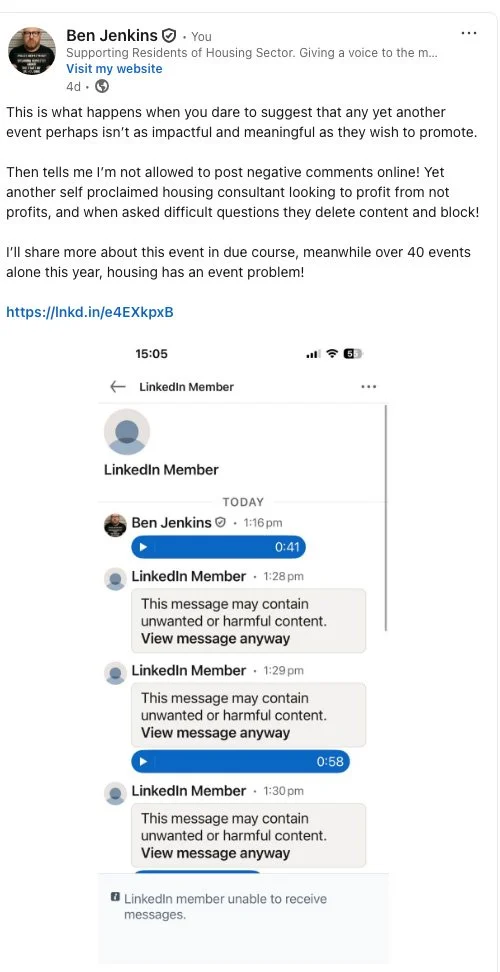
I published a short personal LinkedIn post explaining that my question had been deleted, I had been blocked and I had been told not to leave negative comments. Because the block prevented readers from seeing parts of the original exchange, I shared the screenshots I still held and explained that limitation.
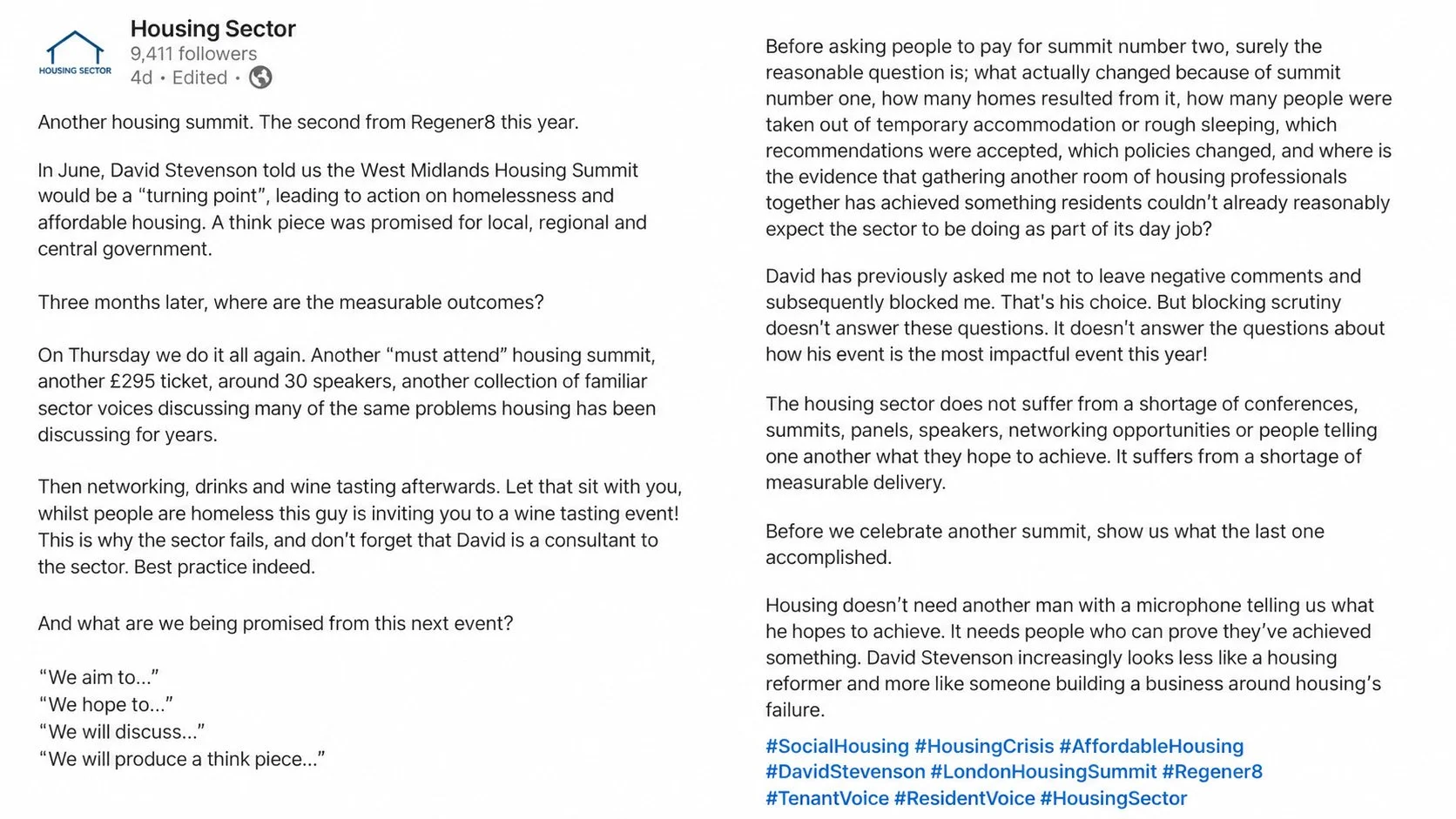
The Housing Sector then published a fuller post examining the claims made for the London summit. It asked what measurable outcomes had emerged from Birmingham before people were asked to pay £295, plus a booking fee, to attend another event. The London package included refreshments, lunch, networking, a drinks reception and wine tasting.
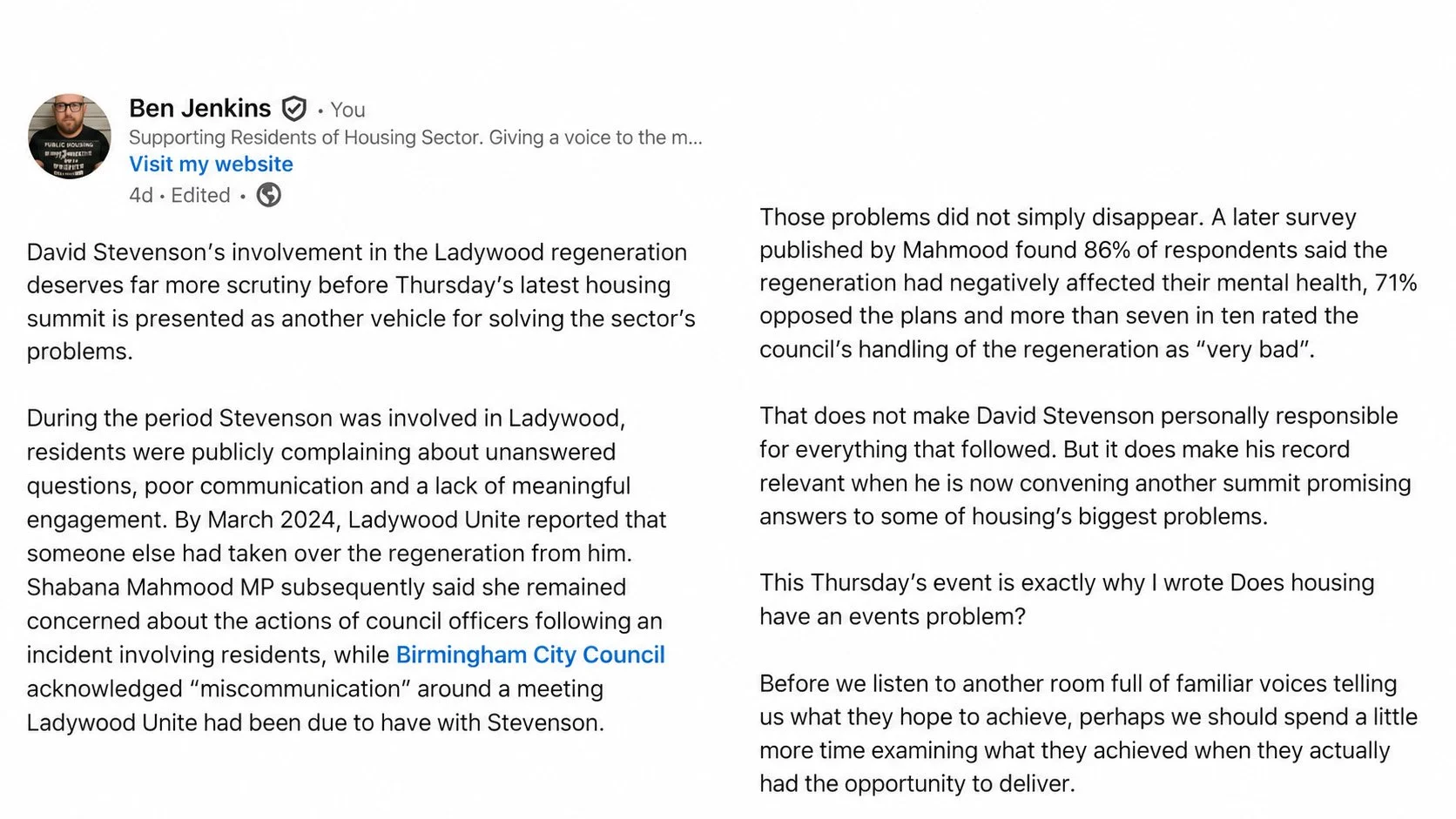
I later reposted the Housing Sector article from my personal account with additional commentary. The posts were critical, but they explained their factual basis and distinguished between hopes, planned activity and demonstrable results.
One concluded:
“Housing doesn't need another man with a microphone telling us what he hopes to achieve. It needs people who can prove they've achieved something.”
Looking back at the comment I left on LinkedIn before everything that followed unfolded, my initial assessment proved remarkably accurate. As I will explain later, my main concern was how easy it was to peek behind the curtain. If it had taken me just ten minutes to discover this, why had none of the speakers now lending their names to the event done the same, and dare I suggest, why hadn’t the people being asked to fork out £295 for a ticket peeked behind the curtain themselves?
Readers can judge whether that opinion was fair. What David did not do was identify a specific factual statement and provide evidence showing why it was wrong.
The Messages, Deadlines and Threats
Once the posts appeared, the original question was almost buried beneath an extraordinary volume of calls, texts, voice notes, deadlines and threats.
The sequence matters. I made one 45-second call at 15:02 on Sunday. Later, David called me at 18:47 and attempted further calls at 18:48, 19:16 and 19:17. After legal action was raised during the 18:47 call, I decided all communication needed to remain in writing.

At 19:03, I wrote:
“I've received your voicemail. Given the concerns relate to something I've published, I'd prefer to keep this in writing. If there is anything you believe is factually inaccurate or unfair, please send me the specific points and I'll review them.”
At approximately 19:09, David threatened to place the matter in the hands of solicitors if anything was defamatory or personally critical. He demanded removal and said he would ask LinkedIn to suspend my account.
At 19:13, I replied:
“David, I note your position. As you have now threatened legal action, I will not discuss the substance further directly.”
That was my position from then onwards. I did not answer his individual demands and deadlines.
Three minutes later, he ordered me to remove the post within ten minutes or face immediate legal action. Across the following days he repeatedly demanded deletion, suspension, an apology or a retraction—without clearly identifying the particular words he said were false.

David alternated between threats and attempted compromise. He proposed a private meeting, offered me a place in the combined summit think piece and said he agreed with some criticism of the conference “bandwagon”. He then returned to claims of harassment, defamation, distress and reputational damage.
Amid the threats and demands, David also made one revealing concession:
“The ironic thing is I actually agree with some of the comments on your LinkedIn page about the conference bandwagon and corporate backslapping.”
The dispute, therefore, did not appear to be entirely about my criticism of housing’s events culture. The real objection seemed to be that I had applied that same scrutiny to his event.
That moment of agreement did not last long, David quickly changed his tune again. He demanded a “full apology, fully blown apology”, called me a “bloody keyboard warrior” and warned:
“You've crossed the wrong person here, I'm afraid.”
He added:
“I would think about it very, very, very carefully if I were you.”
The messages continued into the night. At 00:25 on Monday he wrote, “It's past midnight and still no apology. You have had your chance,” and said he would report me to the police.
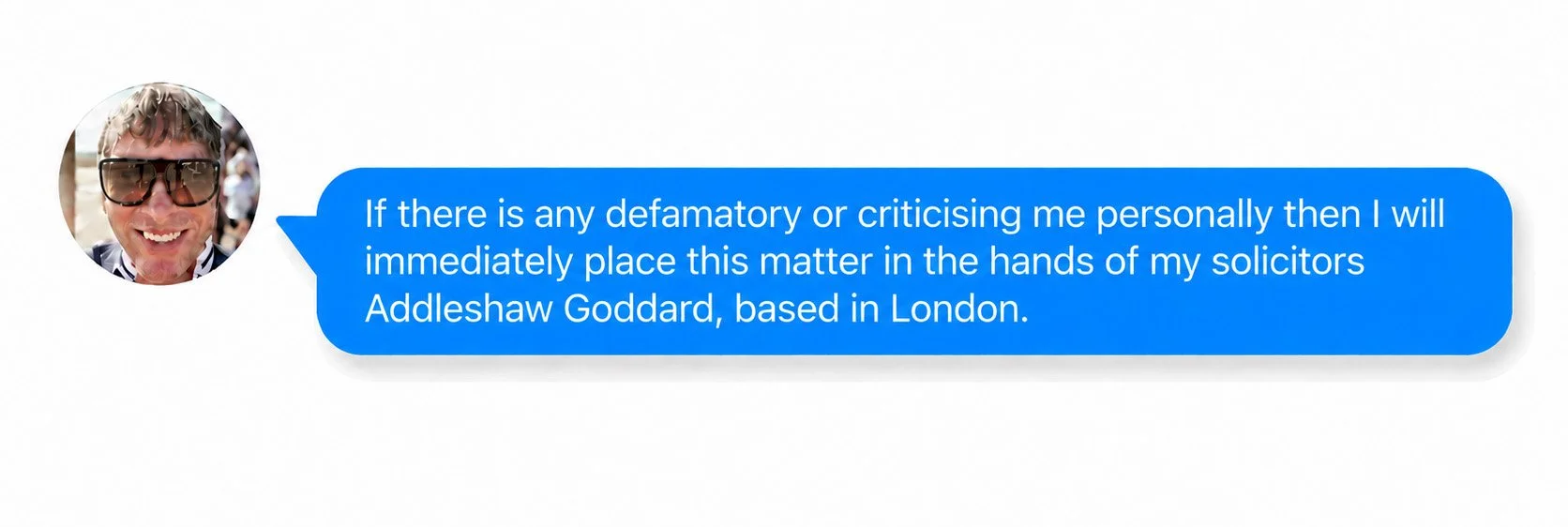
David repeatedly invoked solicitors, police, LinkedIn, sponsors and the legal teams of other organisations. He predicted arrest, said I could face a custodial sentence and later instructed me not to publish anything further or attend the summit. I had never said I would attend.
On at least three separate occasions, David invoked Goodman Masson, claiming that sponsors wanted a full apology and threatening to involve “my and Goodman Masson’s lawyers”. I offered Goodman Masson a right of reply and specifically asked whether David had authority to invoke its solicitors; it did not respond, but David subsequently stopped referring to the company and its legal team.
He searched Companies House, sent me my registered home address and asked me to confirm it. A public address remains public information, but sending it in the middle of repeated police and legal threats felt intended to intimidate.
He also wrote:
“My network and reach is considerably greater than yours.”
Audience size proves nothing about who is right. However, because David invoked it, the visible figures provide context. At the time, his LinkedIn account displayed around 5,000 followers. My personal LinkedIn account had nearly 17,000, the Housing Sector page had more than 9,000, and our combined platforms showed more than 28,000 follows and subscriptions.
Those audiences overlap and are not 28,000 separate people. Nor do they include everybody who reads or watches without subscribing. Across the Housing Sector websites, 2026 figures showed more than 26,000 visits and over 42,000 pageviews. Recent content, mostly published over approximately three months, had reached thousands: one TikTok video exceeded 6,000 views, YouTube Shorts exceeding 1,000 and individual LinkedIn posts generated thousands of impressions.
I do not include those numbers because they make me right. A resident with no followers would have been equally entitled to ask the original question. I include them because David tried to use supposed superiority of reach as leverage while questioning who I represented.
The Sponsor Contradiction and Escalating Claims
While David’s messages were arriving, one of the event’s advertised sponsors contacted me privately. Its representative explained that he and a colleague had decided not to attend before my post was published and that their company had been “disassociated with the event” for some time. He asked me to remove the sponsor from my post and said David had assured him that its details would be removed from the event website the following morning. This raised a further question; why was the website still advertising an organisation as a sponsor when, according to its own representative, it had already been disassociated from the event for some time?
I removed the reference within 15 minutes, confirmed that I had done so and was thanked for acting promptly.
That chronology became important when David later claimed that my post had caused the summit's main sponsor to withdraw, creating a direct loss of £2,000. He said he would invoice me and seek further direct and indirect losses.
The two accounts conflict. The sponsor's representative said the withdrawal pre-dated my post; David attributed it to my post. No evidence was provided showing causation or explaining the £2,000 calculation.

David also said he would record the time spent on the dispute and invoice me at a day rate of £800–£1,000. His claimed immediate losses subsequently rose from £2,000 to £2,800 and then £3,200, with alleged ticket-sale losses still to be calculated. No calculation, third-party invoice, contract or evidence linking those sums to my publications was supplied.
Anyone can issue an invoice. That does not establish that the recipient owes the money.
Bizarrely, at 21:41 on Monday 14 September, amid the continuing demands and legal threats, David sent me a seven-minute promotional video for the summit. In it, he said regulation should be “relaxed” for the best-performing registered providers, allowing them “to take the development risks that they need to and maximise their financial capacity to get building as soon as possible”. He suggested that rough sleeping “could be ended before Christmas”, promoted £295 tickets and free wine tasting, promised a think piece within a fortnight and declared: “We’ve now got the authority of government. We’ve got the finance, and I think we’ve got the capacity within the sector to deliver this. Let’s get on with it.” He concluded by predicting the economic benefits of a “housing boom”. Once again, we can see that David is not short of words.
A Formal Right of Reply
Despite the volume of contact, it was important to give David a fair opportunity to state his case. On Tuesday morning I sent a formal written right of reply.
I asked him to identify the specific statements he said were inaccurate, explain his repeated demands and threats, reconcile the sponsorship claim with the written account I had received, and add anything else needed to represent his position fairly.
The frequency, changing tone and contradictions in his communications had also caused genuine concern. Without attempting to diagnose him, I asked whether there was any mental-health, wellbeing or communication issue I should take into account.
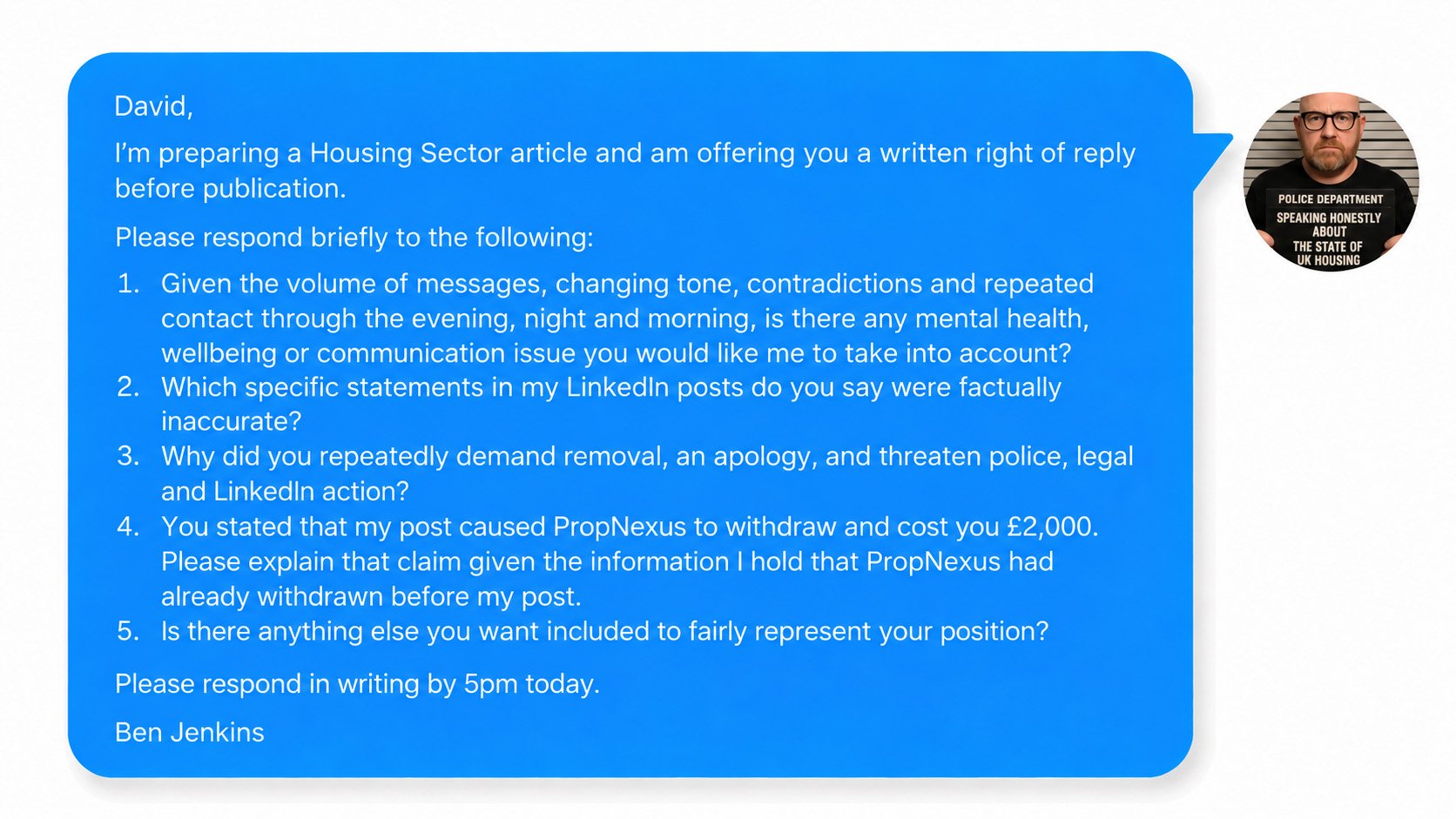
David did not answer the substantive questions. He said he had made a formal police complaint, told me to do nothing further and repeated that he was not accountable to me.
I attended a police station to establish whether any complaint from David Stevenson had been recorded against me. Spoiler; as of 5pm on Thursday 17th September, I was told that no such complaint could be found on the police system. David may have contacted or visited the police, but there was no complaint on file that officers could identify. Whether he reported the matter at all therefore remains yet another unanswered question.
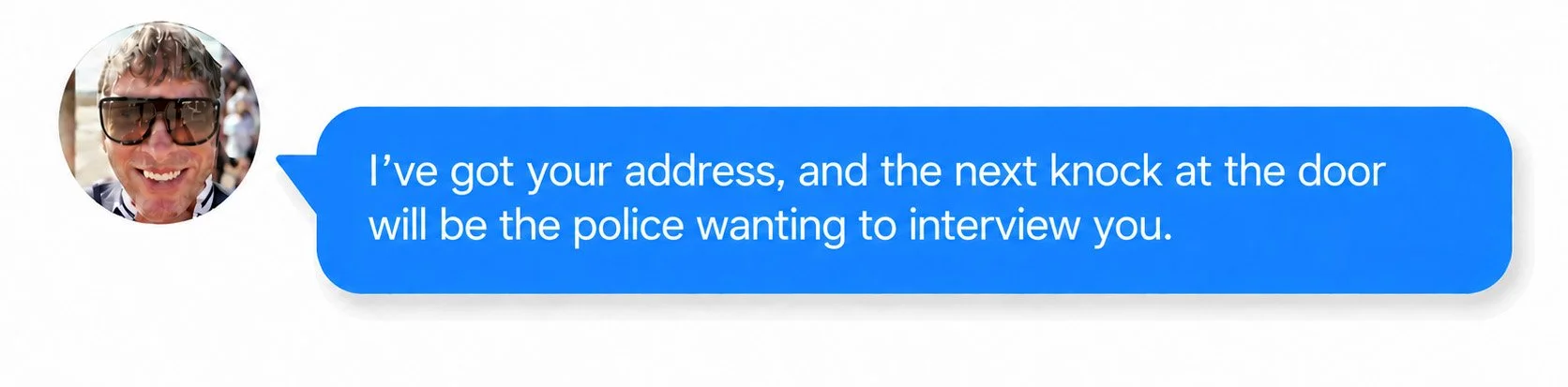
Later, he said he could not meet the deadline because he was in Wales and could respond fully the following day. Eleven minutes later, another lengthy message arrived containing further warnings and another apology deadline. The following day he expressly declined the right of reply.
David was entitled not to answer. But he cannot reasonably say he was denied an opportunity. He was repeatedly invited to identify a factual error and provide supporting evidence. The opportunity was there; the central questions remained unanswered.
Calling in the Network
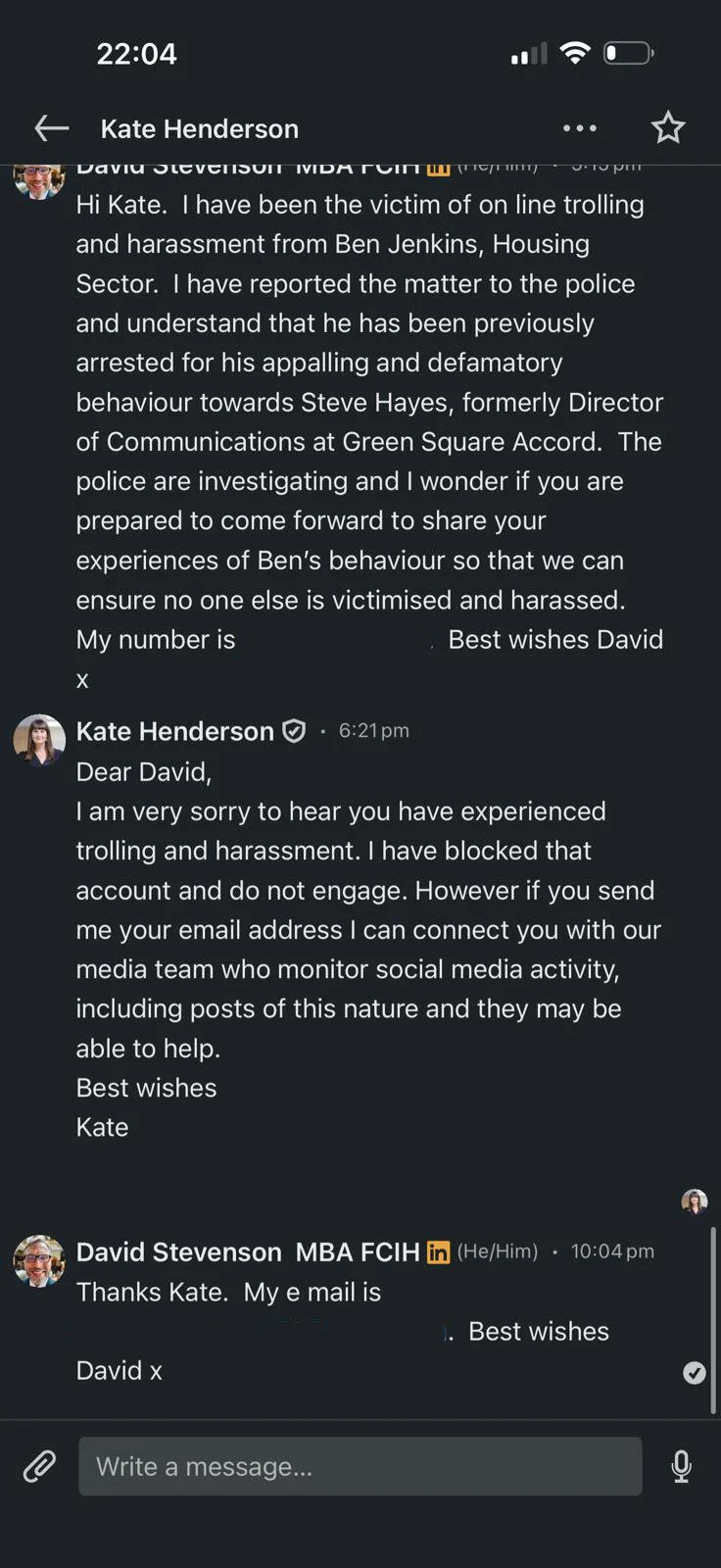
David then brought other housing figures into the dispute. He said he had contacted Steve Hayes and sent me screenshots of private LinkedIn exchanges he initiated with Kate Henderson, chief executive of the National Housing Federation, and Ruth Cooke, chief executive of GreenSquareAccord.
He later claimed that both women would speak to police. The screenshots showed a narrower picture.
Kate expressed sympathy, said she had blocked my account and offered to connect David with the National Housing Federation's media team. Her message did not say she would contact or speak to police.
Ruth referred to GreenSquareAccord’s previous dealings with me, saying that the organisation had taken court action to protect colleagues, although she acknowledged that it had been “a pretty imperfect solution all in all”.
She added:
“I’m happy to speak to the police if it would be of help, and I’m sure Steve would be as well.”
That description rather understates the outcome. GreenSquareAccord’s attempts to enforce the court undertakings were dismissed, with the organisation ordered to pay the costs. The subsequent police action resulted in no charge and no further action because there was insufficient evidence. Far from resolving the criticism, both episodes attracted further unwanted attention to GreenSquareAccord’s conduct and governance, and the resulting reports and videos remain among the most actively read and watched material on my website. Ruth’s message represented a conditional willingness to assist, not evidence that an offence had occurred or that anybody had independently verified David’s account.
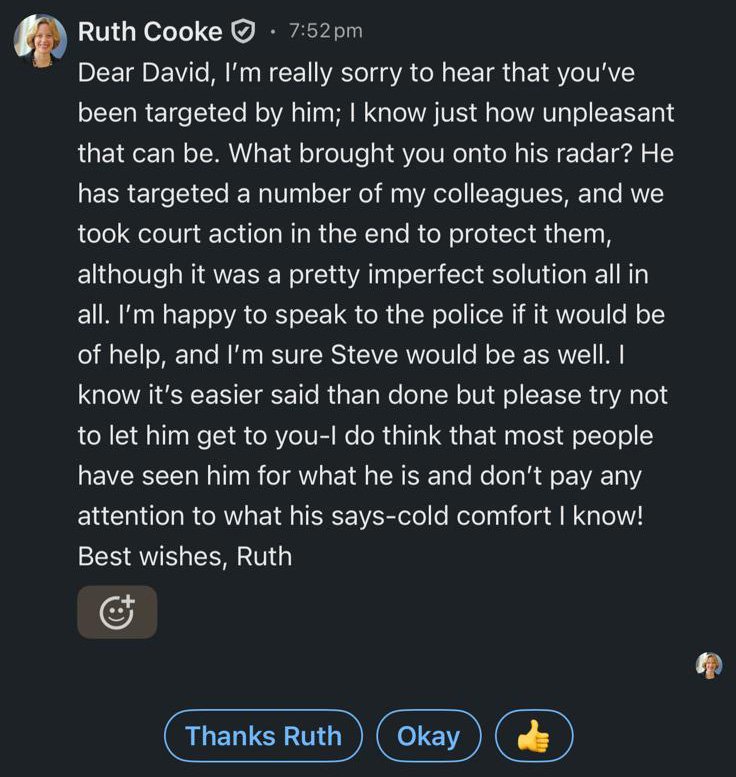
The significance lies in how the names and private messages were used. David supplied the screenshots to increase pressure and then described them more strongly than their contents justified. None showed an independent examination of the posts at the centre of the dispute.
This also reflects a wider problem. Senior sector contacts, legal language and institutional communications teams can quickly become a shield against criticism. Sympathy for somebody reporting distress is understandable. But a responsible response also asks what was published, what is said to be false and what the evidence shows.
The National Housing Federation's own code of conduct emphasises integrity, fairness, responsibility and care. Those principles should apply when residents, campaigners or independent publishers ask difficult questions—not only when the sector speaks about accountability on conference stages.
When a Speaking Slot Becomes an Endorsement
Two advertised speakers contacted me privately after the posts appeared. Both accepted questions about outcomes. I am not naming them because they do not deserve to be dragged into a dispute they did not create.
The separate sponsor contact is addressed above. It came from a sponsor that said it had already withdrawn before my post.
These contacts matter because appearing on an event programme lends the organiser credibility. A speaking slot, logo or promotional graphic tells prospective attendees that respected professionals consider the platform worthy of their names.
Speakers cannot be expected to foresee every private action of an organiser. They can reasonably be expected to perform basic due diligence. Who is running the event? What legal entity is taking the money? What happened after the previous summit? Were promised outputs published? What evidence supports claims of success? What standards govern the event if concerns arise? And lest we forget our original question, what is it that makes this event so meaningful?
I had been aware of David for only a few days when public records, contemporary reporting, residents' evidence and his own communications began raising serious questions. That does not make every conclusion automatic, but it does make it difficult to understand what checks were undertaken before so many sector figures lent their names to the event.
David told me he had further events planned, and with two summits organised within 15 weeks, he clearly had an appetite for more. But the sector must ask whether it needs yet more events—particularly those built on little more than ambitious aspirations.
The proposed solutions were enormous. David spoke of ending rough sleeping, influencing councils and housing providers, changing regulation, removing barriers to development and sending a think piece to government. At points he suggested rough sleeping could be ended by autumn or Christmas if providers ring-fenced their next lettings.
Those ambitions cannot be delivered by hope, a panel discussion or an emailed report alone. Publishing a think piece is an output. The test of impact is whether anyone adopts its recommendations, commits resources and produces change that can be measured.
If recognised housing figures agree to appear at almost any event that offers a microphone, their endorsement loses value. So does the wider events circuit. More events divide attention, repeat familiar conversations and make it harder to distinguish serious work from marketing.
Does Housing Have an Events Problem? Yes
This began with one reasonable question: what made the London Housing Summit more meaningful than the many other housing events taking place that year, and what measurable impact had the first Regener8 summit achieved?
The comment was deleted. The question was not answered.
What followed were repeated calls and messages, demands to remove or suspend posts, multiple apology deadlines, references to police and several legal teams, threats involving LinkedIn, claims for escalating financial losses, the sending of my home address and the use of senior housing figures' names and private messages to add pressure.
Throughout, David said he was not accountable to me. On that narrow point, he was right. He is not personally accountable to Ben Jenkins.
But anybody publicly selling a £295 housing summit while making ambitious claims about homelessness, regulation, housebuilding and government influence should be prepared to substantiate those claims. That is not personal authority. It is public scrutiny.
The conduct documented here raises serious questions about David's judgement and his suitability to lead an event promoted as capable of shaping national housing policy. The evidence from Ladywood residents adds further questions about leadership, communication and measurable delivery. Readers can examine David's words, his messages, his contrasting account of Ladywood and the evidence alongside them, and reach their own conclusions.
The wider lesson is not about one man.
Housing has built an events culture in which intention is too easily mistaken for achievement, familiar names are treated as proof of credibility and difficult questions are sometimes handled as threats rather than opportunities for accountability.
We do not need more events simply because somebody is opportunistic enough to announce one. If new summits are to justify their cost and demand on people’s time, they need serious leadership, credible governance, clear objectives and published measures of success.
Residents are living with unsafe homes, unaffordable charges, damp, mould and failing services. People experiencing homelessness are not helped by declarations of hope and wine tasting alone. These problems require funding, housing supply, coordinated services, sustained support and people capable of turning proposals into delivery.
Good intentions are the starting point. Delivery is the test.
That is why housing has an events problem—and why asking what an event actually achieved should never have produced all of this.

Even my harshest critic, having read this, surely you have to give me this one? I have identified at least two housing events this year that we simply did not need. You can give me these two, at least. Acknowledge me that at least.
Postscript: My Visit to the Police
I attended the police station largely at my wife’s insistence. David had sent me my home address amid a flurry of angry messages, legal threats and warnings about police action. We agreed that the sensible course was to place my concerns on record and establish whether any complaint had actually been made against me.
Across at least 11 separate messages and voice notes, David threatened or claimed police involvement. On three distinct occasions, he went further—predicting that officers would come to my door, that I would be arrested within 48 hours or that I would be arrested “on the spot”.
However, as of 5pm on Thursday 17 September, I was told that no complaint from David Stevenson—or from Ruth Cooke or Steve Hayes—could be found on the police system. David may have contacted or visited a police station, but officers could identify no recorded harassment complaint against me.
The desk sergeant explained that one possibility was that the information presented had not met the threshold for further investigation and therefore had not been recorded as a complaint. Alternatively, David may never have carried out the threat. There is no evidence allowing me to say which.
I was not surprised that neither Steve nor Ruth appeared on the system. GreenSquareAccord had previously taken me to court twice; both cases were dismissed with costs. The police arrest connected to Steve Hayes also ended with no further action because he could provide no evidence to support the allegation.
Perhaps David, Steve and Ruth can share their views on online harassment from the stage at another housing event. Who knows? For now, none of the police consequences David repeatedly predicted has materialised, and there is no recorded police action against me.