
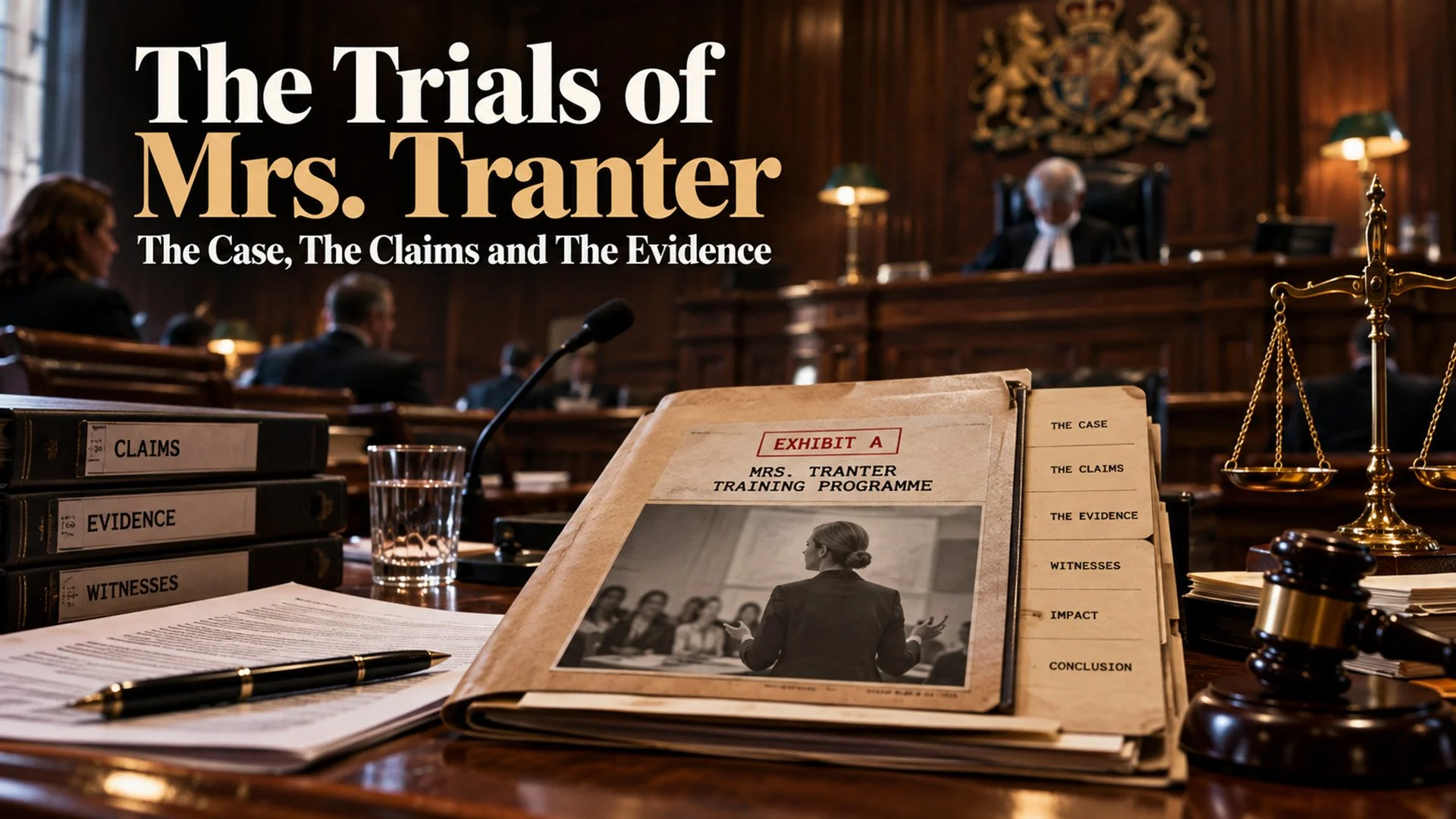
The Trials of Mrs Tranter
The Case, the Claims and the Evidence
I have a background in training, particularly customer service training. During the late 1990s, I led an extraordinary team of people working within BT Conferencing. Part of our role was to evaluate complaints, identify what had gone wrong, listen back to call recordings and follow those breadcrumbs of information until we found the weakness. Once we found it, we fixed it.
Sometimes that meant a focused weekly refresher session covering a particular area of the business. Sometimes those smaller lessons evolved into larger company-wide training policies and initiatives. I was also closely involved in the Dazzle training programme, accredited by Achieve Global. That was many moons ago, and I raise it here for one reason only - I understand the need for training. Well-written, well-placed and well-timed training is essential. You are never too old to learn and, no matter how experienced you are, sometimes we all need refresher training.
The Trials of Mrs Tranter — now being developed and marketed outside GreenSquareAccord in adapted forms — is therefore not something I object to simply because it is a training exercise. In fact, having now had the opportunity to look more closely at the original material, I can see why staff may have found it engaging.
Having had a look at The Trials of Mrs Tranter itself, I am amazed that it has been labelled “game-changing”. It seems fairly mediocre and aimed at a very basic level of customer-service support. With the constant turnover of staff across the sector, I can understand the need to refresh some of those core skills, but if employees genuinely need to be taught that unresolved complaints and service failures have a serious impact on residents, then there is a much wider training problem at the heart of the organisation.
That said, as a company-wide refresher exercise designed to brush up on basic customer-service skills, The Trials of Mrs Tranter is perfectly passable. What I struggle with is how something relatively straightforward has become a multi-award-winning programme, including being described as a “Game Changer”. If this really represents the cutting edge of customer-service training in the housing sector, then the sector may have a much bigger problem than it realises.
But that is not really what this story is about.
The story surrounding The Trials of Mrs Tranter raises much bigger questions about evidence, ownership, commercialisation, awards and what happens when a success story gathers momentum before anyone appears to have stopped and properly interrogated it. Residents and tenants — or, as the sector increasingly wants to call us, customers — should care when success is claimed, repeated and rewarded with industry recognition while their lived experience fails to match the glowing picture being presented on stages, in award submissions and across social media.
The Trials of Mrs Tranter matters not simply because of what the training exercise does. It matters because of what happened around it.
Learning lessons — again
On 18 April 2019, Julianne Britton, then Head of Customer Services at GreenSquare (as they were known then), wrote to me following a complaint involving a failing lift, a major water leak, antisocial behaviour and poor communication. She told me:
“The service you and your neighbours have received in relation to most of the aspects of your complaint has fallen short of what you should be able to expect from us.”
She acknowledged that GreenSquare had placed me in a position where I felt the only way to be heard was to contact board members, committee members and the executive team. On the water leak, I was promised a full investigation and told GreenSquare would ensure its processes were “fit for purpose to avoid similar delays in the future”. Communication, ownership and record-keeping, I was told, “should and could have been better”. Lessons would be learned.
Fast-forward to Complaint 8793, closed at Stage 2 in May 2026. GreenSquareAccord (as they are known now) again identified failures involving communication, ownership and customer experience, while further learning was required around reassurance, escalation ownership and communication during urgent communal safety-related contacts. Its Stage 1 response said:
“We regularly look at trends and themes in order to drive service improvement with the aim of ensuring customers do not see the same mistakes happening over time.”
Then came Complaint 21107, closed at Stage 2 in August 2026.
GreenSquareAccord found that the complaint had been addressed to the wrong person, a telephone number had been inaccurately described, the lift-shaft issue had been misunderstood, the investigation had not fully explored the available information and there had been an unacceptable delay in communication. The Stage 2 reviewer accepted that there had been “several inaccuracies” and that aspects of the investigation “could have been handled more thoroughly”. GreenSquareAccord ultimately offered £250 compensation across Stages 1 and 2.
What makes that particularly striking is how closely the language in the 2026 complaint response echoes what GreenSquare was already saying back in 2019. Seven years apart, different complaints and different staff, yet the same underlying issue around ownership and communication is still being identified.
“The service you and your neighbours have received in relation to most of the aspects of your complaint has fallen short of what you should be able to expect from us.”
And in the more recent Stage 2 response:
“I do not consider the overall handling of the contact provided sufficient reassurance or clear ownership of the issue.”
Different year, different complaint, but remarkably similar failings. That is difficult to reconcile with repeated assurances that lessons are being learned and that residents should not continue experiencing the same mistakes.
In 2019, the language was communication, ownership, record-keeping, escalation and learning. In 2026, the language was communication, ownership, escalation, inaccurate complaint handling — and more learning. Sitting somewhere between those two points was The Trials of Mrs Tranter.
According to GreenSquareAccord, more than 650 people participated in the programme. So despite the training, despite industry recognition and despite impressive claims around complaint performance, one thing remains difficult for me to ignore - the lived experience does not match the PR.
The success story
GreenSquareAccord certainly promoted The Trials of Mrs Tranter as a success. In November 2025, after the initiative was named runner-up in the Institute of Leadership Awards, GreenSquareAccord described it as “our innovative engagement activity”. Steve Hayes, then Director of Corporate Affairs and Communications at GreenSquareAccord, said:
“It is great to see The Trials of Mrs Tranter has had an impact at GSA and is creating a legacy within our sector.”
“Impact and legacy within our sector” are strong words. By 2026, the project was travelling much further. It was appearing at events, being adopted by other housing providers, entering awards and becoming increasingly associated publicly with Hayes.
According to Hayes, the original idea came to him after playing a murder-mystery-style detective game. But when we look at who actually created the finished initiative, the picture is broader than one individual.
GreenSquareAccord's own publications describe the initiative as something the organisation launched, while Hayes himself publicly thanked colleagues who contributed their insight, helped shape the content and embraced the exercise. GreenSquareAccord has subsequently confirmed to me that The Trials of Mrs Tranter was created and developed in-house.
That distinction matters because GreenSquareAccord is a not-for-profit housing association. The staff contributing their time, experience, knowledge, internal information and resources were working for GreenSquareAccord. The complaints learning came from GreenSquareAccord, the case material came from GreenSquareAccord, and the exercise was developed inside GreenSquareAccord. Yet the project subsequently became part of a commercial offering outside GreenSquareAccord.
That is where the story becomes considerably more interesting.
The 43% claim
One of the most eye-catching claims surrounding The Trials of Mrs Tranter was the suggestion that complaints had fallen by 43%. Let me assure you, as a long-suffering shared ownership resident who has spent years raising some of the same issues repeatedly, a genuine 43% reduction in complaints would be something I would welcome. If my housing provider genuinely reduced complaints by fixing the problems causing them, Housing Sector would happily report that success.
But the 43% figure requires considerably more context than the headline gives it. An earlier version of Creative Bridge's marketing referred to a 43% fall in complaints reported by one provider. The Institute of Internal Communication's finalist material subsequently stated that since the launch of The Trials of Mrs Tranter, complaints at GreenSquareAccord had fallen by 43%.
The underlying figures are real. GreenSquareAccord confirmed that complaints fell from 597 in March 2025 to 340 in December 2025 — approximately 43%. But GreenSquareAccord also made something else very clear. Sophie Atkinson, Executive Director of Governance, told me:
“I have not reviewed any claims regarding the reduction in complaints being solely attributable to the Mrs Tranter case study. This would not be the case.”
She continued:
“GSA has seen a substantive reduction in complaints over the last few months but this is attributable to a large number of changes we have made in our processes. Mrs Tranter is just one element of an enhanced programme of customer service training that we delivered to teams across the business.”
That matters because saying complaints fell by 43% during the period in which Mrs Tranter was operating is not the same as saying complaints fell by 43% because of Mrs Tranter. GreenSquareAccord itself says the reduction was attributable to numerous changes.
There is another complication. GreenSquareAccord's own Annual Complaint and Service Improvement Report said changes to its complaint processes meant complaint volumes could not accurately be compared with previous years. During the same general period, GSA was changing complaint processes, introducing wider service improvements and responding to Housing Ombudsman scrutiny.
The available evidence therefore shows that complaints fell. It does not establish that The Trials of Mrs Tranter caused that fall. That is quite an important distinction when a number is being used to demonstrate the success of a training initiative.
“Praised by the Housing Ombudsman”
Then there was another phrase attached to the success story: “Praised by the Housing Ombudsman.” Again, it sounds impressive, but the context matters.
GreenSquareAccord did receive positive feedback from the Housing Ombudsman regarding its wider complaints performance. However, Sophie Atkinson subsequently clarified this directly with me:
“In our original award application the exact quote is stated which is in relation to the wider reduction in complaints rather than the Mrs Tranter case study itself.”
That could hardly be clearer. The Housing Ombudsman praised GreenSquareAccord's wider complaint-handling performance. On the evidence provided to me, it did not specifically praise The Trials of Mrs Tranter. Yet the Housing Ombudsman praise became associated with the wider Mrs Tranter success story.
Creative Bridge's current marketing no longer carries the earlier 43% wording or the previous Housing Ombudsman wording. I cannot say why that wording changed. What I can say is that the stronger claims had already travelled: they had been repeated, publicised, placed in front of judging panels and incorporated into the story surrounding an increasingly award-winning project.
Which brings us to the awards.
And the winner is…
The awards cabinet has become rather crowded. In 2025, The Trials of Mrs Tranter was runner-up in the Institute of Leadership Awards. In July 2026, it won four Gold awards at the Internal Communications and Engagement Awards.
Then, on 17 September 2026, came another significant result. The Trials of Mrs Tranter won Game Changer and Most Innovative Content Creation at the Institute of Internal Communication Awards. The IoIC's official results list both wins as “The Trials of Mrs Tranter by GreenSquareAccord.”
And I am pleased about one thing - the recognition belongs to GreenSquareAccord, not Steve Hayes. That is important because everything I have subsequently discovered shows that this was not simply the work of one man. An idea may originate with an individual, but turning that idea into an actual programme requires other people. GreenSquareAccord employees contributed, GreenSquareAccord resources were used and GreenSquareAccord's complaint experience formed the foundation.
So if the industry believes Mrs Tranter deserves awards, it seems entirely appropriate that GreenSquareAccord and the people who helped create it receive the recognition.
But having now looked at The Trials of Mrs Tranter myself, I confess I am still scratching my head slightly at one particular award. Game Changer. I can see why the exercise might be engaging, and I can understand why staff might prefer working through an interactive fictional complaint case to sitting through another PowerPoint presentation. I can also understand why somebody thought it was creative. But a game changer? Perhaps I am a difficult audience.
A small world
There is some additional context readers may wish to consider. Steve Hayes is a Fellow of the Institute of Internal Communication, and IoIC describes Fellowship as recognition for senior practitioners who have made an outstanding contribution to the profession. Hayes was also a speaker at the 2026 IoIC Festival, where his subject was The Trials of Mrs Tranter.
He is also publicly identified as an IoIC Awards judge. His professional website lists him as a Fellow of the Institute of Internal Communication, a keynote speaker at the IoIC Festival and an “Awards judge, ICE Awards & IoIC Awards”. In the run-up to this year's ceremony, Hayes also publicly referred to helping judge the awards “again this year”.
Then, on 17 September, The Trials of Mrs Tranter by GreenSquareAccord won two IoIC awards.
I have found no evidence that Steve Hayes judged either of the categories won by The Trials of Mrs Tranter, nor am I alleging that he influenced their outcome. Readers can decide for themselves what significance, if any, they attach to the relationships and connections within what is ultimately a relatively small professional community.
What interests me more is the evidence. Nearly 300 entries were submitted to the 2026 IoIC Awards, which makes the recognition significant. But it also brings us straight back to the question at the heart of this article: what exactly is being validated when something wins an award?
Recognition is not verification
When I previously approached the Institute of Internal Communication about the evidence supporting award submissions, the distinction between judging and independent verification became important. An awards panel can professionally assess the information placed before it. It can assess originality, presentation, creativity and strategy. But an award does not necessarily mean every statistic and underlying claim contained within the submission has been independently audited.
That distinction matters enormously once the award itself begins being used as further evidence that the initiative was successful. Otherwise, the logic becomes circular; an organisation produces a success story, the success story contains impressive performance claims, the success story enters an award, the judges assess what has been submitted, it wins, and the award is then promoted as further proof of the success story.
But if the underlying claims were never independently established, what has actually been validated? The presentation? The creativity? The communication? Or the underlying outcome? Those are not necessarily the same thing.
This is precisely why weakly scrutinised awards potentially damage people who genuinely deserve recognition. A housing professional who has delivered something extraordinary should be proud to receive an award, and they should also be able to rely upon that award meaning something.
There was at least one constructive outcome from raising these questions. In its response to me, the Institute of Internal Communication was unusually frank about the limits of its awards process and confirmed that it intends to introduce additional safeguards from 2027.
IoIC Chief Executive Jennifer Sproul told me:
“It is not possible for us to independently verify every claim or metric in the 300+ entries we receive; we do not have access to confidential and proprietary information and rely on what is submitted to us.”
She also acknowledged that the issues I had raised prompted a wider question about how awards processes deal with situations of this kind:
“We do think this raises a fair question about how awards processes handle situations like this, and we are acting on it.”
From 2027, IoIC says entrants will face an additional declaration:
“All entrants will be required to confirm that their entry aligns with the IOIC Code of Conduct — the professional standards our members already commit to — and to declare that the information they submit is accurate and truthful, with an obligation to notify us of any material change that arises after submission.”
That is a sensible and welcome change. It does not turn an awards body into an investigative auditor, but it does place a clearer responsibility on entrants to stand behind the accuracy of the claims they submit.
From not-for-profit to commercial product
There is another aspect of this story which concerns me considerably more than trophies. GreenSquareAccord has confirmed that The Trials of Mrs Tranter was “a customer service training initiative created and developed in-house by GreenSquareAccord”.
Sophie Atkinson also told me:
“No formal legal agreement was entered into and no payments were made to Creative Bridge by GSA or vice versa.”
That is extraordinary when you consider what happened subsequently. We have an initiative created inside a not-for-profit housing association using its staff, knowledge and resources. Versions of that initiative subsequently became a commercial product marketed to other housing providers by a private company.
Steve Hayes subsequently left GreenSquareAccord and moved into a more active role with Creative Bridge. His own consultancy website currently says that “12 housing associations have adopted The Trials of Mrs Tranter, the award-winning engagement exercise I created.”
But there was no formal legal agreement governing the original arrangement between GreenSquareAccord and Creative Bridge. GreenSquareAccord has since examined the position and asserted intellectual property rights over its original Mrs Tranter materials, including its content, photographs, letters and templates. Sophie Atkinson told me Creative Bridge accepted that position.
GreenSquareAccord has also offered something rather interesting: it is prepared to provide its original Mrs Tranter content to other housing providers free of charge, provided those organisations adapt the material appropriately and do not simply reuse GSA's letters and templates. Creative Bridge's commercial value, according to GreenSquareAccord, comes through adapting and developing bespoke versions.
That leaves an obvious question for housing providers that have already bought versions: what exactly did you pay for? How much was genuinely bespoke development? How much originated in material created at GreenSquareAccord? What due diligence was carried out before purchasing it, and did procurement teams understand the ownership arrangements?
These are not trivial questions when not-for-profit housing providers are spending money ultimately derived from rents, service charges and public funding.
I contacted the housing associations involved and put a series of reasonable questions to them as part of a right to reply. None responded. That silence is notable. It may simply reflect a reluctance to engage, but it also creates the impression of organisations closing ranks when uncomfortable questions are raised about procurement, due diligence and the basis on which commercial decisions were made.
Perhaps those decisions were properly scrutinised and the organisations simply chose not to explain them. Perhaps the absence of a response reflects weaknesses in the procurement process or a failure to examine the provenance, ownership and performance claims surrounding the product closely enough before purchasing it. It may also suggest that people were too willing to accept the success story presented to them without testing it properly. That is precisely the scrutiny I have tried to apply here at Housing Sector; not simply repeating the claims, but going back to the evidence and asking whether they actually stand up.
The organisations publicly associated with The Trials of Mrs Tranter include; Magna Housing, Nottingham Community Housing Association, Karbon Homes, Watmos Community Homes, Greatwell Homes and Gentoo Group. Steve Hayes has publicly stated that 12 housing associations have adopted the programme, but the other five have not been publicly identified in the material I have been able to verify.
Having now seen Mrs Tranter
When I first started looking at this, I deliberately avoided judging the actual training package because I had not seen enough of it. That has now changed. I have subsequently had the opportunity to examine the original material in considerably greater detail, and I want to be fair: I don't think The Trials of Mrs Tranter is inherently a bad training exercise.
There are things about it I actually quite like. Using evidence, correspondence and fictionalised material to make staff work through a complaint can be far more engaging than simply telling people what good customer service looks like. It asks participants to interrogate information, reconstruct what happened, identify failures and consider how those failures affected a resident. Those are all perfectly sensible training principles.
What I struggle with is the mythology subsequently built around it. Having now looked at the exercise, I don't see some revolutionary transformation of customer-service training. I see a creative and potentially useful way of packaging established training principles. Perhaps that is enough to win Most Innovative Content Creation. Whether it genuinely constitutes a Game Changer is something readers — and presumably the IoIC judges — can decide for themselves.
The bigger problem was never really the folder, the game or Mrs Tranter herself. It was what happened afterwards.
The echo chamber
This story touches on something I have increasingly found while examining the housing events and awards circuit. The same names appear repeatedly. People speak at each other's conferences, sit on panels, judge awards, congratulate one another, nominate one another, share posts, become Fellows, appear on advisory boards and then return the following year and do it all again.
There is nothing inherently improper about professional networking. Every industry has networks. The problem comes when familiarity begins replacing scrutiny. The stronger somebody's professional reputation becomes, the easier it can become for their claims to travel without challenge. The more awards something wins, the more credible it appears, and the more credible it appears, the easier it becomes to sell.
Eventually everyone is pointing to everyone else's recognition as evidence that the original proposition must have been sound. That is where independent scrutiny becomes essential. The communications profession, of all professions, should understand that presentation and reality are not always the same thing.
What did residents win?
There is also a much simpler perspective - the resident perspective. Awards do not happen in a vacuum. There are entry fees, tickets, tables, travel, hotels, staff time, conference appearances and marketing, and ultimately those costs sit somewhere within organisational budgets.
Housing associations repeatedly tell residents that financial pressures require difficult decisions. Repairs budgets are under pressure, staffing is under pressure, investment programmes are under pressure and service charges rise. Yet the events and awards circuit continues. Residents are therefore entitled to ask whether that expenditure produces value.
When an organisation wins an award for customer experience while some of its residents are still fighting over repairs, safety, lifts, damp, security or communication, there is an obvious disconnect. The ceremony photograph tells one story; the resident's home may tell another.
The question is therefore very simple - what exactly did we win?

In conclusion
The Trials of Mrs Tranter was created inside GreenSquareAccord. GreenSquareAccord staff contributed to it, GreenSquareAccord resources supported it and GreenSquareAccord's experiences with complaints provided its foundation. The exercise subsequently became increasingly associated with Steve Hayes and was developed commercially outside GreenSquareAccord through Creative Bridge.
Claims around a 43% reduction in complaints require significant qualification. Housing Ombudsman praise related to GreenSquareAccord's wider complaint performance rather than specific praise of Mrs Tranter. GreenSquareAccord subsequently asserted its intellectual property rights over its original material and is now prepared to make that original material available to other housing providers without charge, subject to sensible restrictions.
And the awards kept coming; four Gold ICE awards and two IoIC awards, including Game Changer. Meanwhile, Steve Hayes is a Fellow of IoIC, has spoken at its Festival about Mrs Tranter and is himself publicly identified as an IoIC Awards judge. Those are the facts, and readers can draw whatever conclusions they consider appropriate from them.
For my part, I am actually pleased that the latest awards have been recorded as belonging to GreenSquareAccord. That seems right because, whatever anyone subsequently says about who “created” Mrs Tranter, the finished project was developed within a not-for-profit housing association by more than one person. Those people deserve acknowledgement.
But recognition should never replace scrutiny. An award should not end the questions. If anything, the greater the claim and the greater the recognition, the stronger the evidence should be.
There is perhaps an irony in all of this. The Trials of Mrs Tranter was designed to teach staff to interrogate evidence, reconstruct events, identify failures, take ownership and learn lessons. That is precisely what I have done with The Trials of Mrs Tranter itself.
Perhaps putting Mrs Tranter on trial was the most appropriate way to discover what she really has to teach us.
For a sector that celebrates scrutiny, we have to ask why these questions were not asked before. Why, yet again, does it fall onto me and my independently run and funded Housing Sector website to challenge the evidence being presented and ask the uncomfortable questions? And for doing so, I get the backlash!
So, the jury is still out on The Trials of Mrs Tranter.
I rest my case.